Why Post-Surgical Physiotherapy Matters
Surgery addresses the mechanical issue — it repairs the torn ligament, stabilises the fracture, decompresses the herniated disc. But it doesn’t magically restore function. Without rehab, your dog faces some real problems:
The Consequences of Skipping Physiotherapy
– Muscle wasting — dogs can lose 15-20% of muscle mass within just 2 weeks of restricted activity. In the operated leg, it’s often worse.
– Scar tissue adhesions — without controlled movement, scar tissue forms in a messy, disorganised way. That means restricted range of motion and chronic stiffness down the line.
– Joint stiffness — leave a joint immobile too long and the capsule tightens. Getting movement back becomes harder the longer you wait.
– Compensatory habits — your dog learns to move in weird ways to avoid the surgical limb. Those habits create new problems elsewhere in the body.
– Chronic pain — unmanaged post-surgical pain can cause central sensitisation, where the nervous system essentially turns up the volume on pain signals. That makes everything harder.
– Behavioural changes — prolonged pain and forced rest can lead to anxiety, low mood, and fear-based behaviours. We’ve seen dogs who were outgoing and playful become withdrawn after surgery. It’s heartbreaking.
The Evidence for Post-Surgical Physiotherapy
The research backs this up strongly:
– A 2019 study in Veterinary Surgery found dogs receiving physio after TPLO surgery returned to full weight-bearing 3 to 6 weeks earlier than those without rehab
– Dogs with IVDD who started rehab within 72 hours of surgery had a 78% rate of independent walking recovery, versus 58% without early rehab (Journal of Veterinary Internal Medicine, 2021)
– Post-surgical physio reduced meniscal injury rates after cruciate repair by 35% (Veterinary and Comparative Orthopaedics and Traumatology, 2020)
At RehabVet, we work directly with veterinary surgeons across Singapore to make sure the transition from surgery to rehab is seamless. Our physiotherapy services can begin as early as 48 hours post-op.
—
Common Surgeries That Require Physiotherapy
Physio benefits recovery from pretty much any surgery, but it’s especially important after these:
Orthopaedic Surgeries
| Surgery | Purpose | Typical Recovery with Physiotherapy |
|---|---|---|
| TPLO (Tibial Plateau Levelling Osteotomy) | Cruciate ligament stabilisation | 12-16 weeks |
| TTA (Tibial Tuberosity Advancement) | Cruciate ligament stabilisation | 12-16 weeks |
| Femoral Head Ostectomy (FHO) | Hip joint removal (severe hip dysplasia) | 8-12 weeks |
| Total Hip Replacement (THR) | Full hip joint replacement | 12-16 weeks |
| Fracture Repair (plates, pins, external fixators) | Bone stabilisation | 8-16 weeks depending on fracture |
| Luxating Patella Repair | Kneecap stabilisation | 8-12 weeks |
Spinal Surgeries
| Surgery | Purpose | Typical Recovery with Physiotherapy |
|---|---|---|
| Hemilaminectomy | Disc herniation decompression (IVDD) | 4-12 weeks (varies with severity) |
| Ventral Slot | Cervical disc decompression | 6-12 weeks |
| Lumbosacral Stabilisation | Spinal nerve decompression | 8-16 weeks |
Soft Tissue Surgeries
– Tendon and ligament repair — collateral ligament repair, Achilles tendon surgery
– Muscle repair — after traumatic tears
– Amputation — and yes, physio matters for amputees too. They need to learn completely new movement patterns and we need to prevent overuse injuries in the remaining limbs
—
The Post-Surgical Recovery Timeline
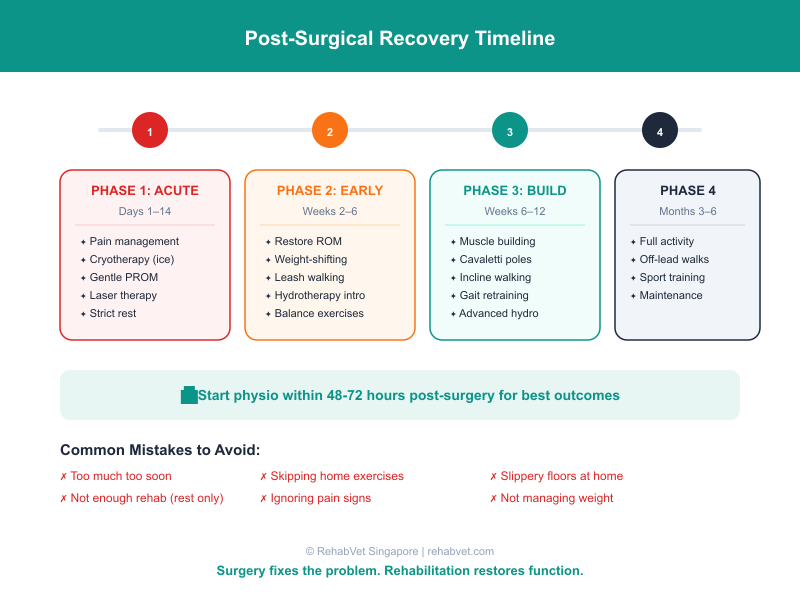
Every dog is different. Recovery depends on the surgery, your dog’s age, their general health, and honestly — how committed you are to the rehab programme. But most post-surgical recoveries follow a predictable four-phase pattern:
| Phase | Timeframe | Primary Goals |
|---|---|---|
| Phase 1: Acute | Days 1-14 | Pain control, reduce swelling, protect surgical site, gentle movement |
| Phase 2: Early Rehab | Weeks 2-6 | Restore range of motion, begin strengthening, introduce hydrotherapy |
| Phase 3: Rebuilding | Weeks 6-12 | Progressive strengthening, gait retraining, functional exercises |
| Phase 4: Return to Activity | Months 3-6 | Full activity, sport-specific training, maintenance programme |
Let’s go through each one.
—
Phase 1: Acute Recovery (Days 1-14)
The first two weeks are about protection and pain control. Your dog’s body is doing the hard work of initial healing — bone callus formation, soft tissue repair, getting inflammation under control.
Goals
– Keep pain and swelling in check
– Protect the surgical site
– Prevent total disuse of the limb
– Start gentle passive movements
What Your Physiotherapist Will Do
– Cryotherapy (ice) — applied to the surgical area for 10-15 minutes, several times a day, to bring down swelling and pain
– Passive range of motion (PROM) — gentle, pain-free movement of the joints above and below the surgical site to prevent stiffness. We’ll teach you how to do this at home too.
– Light massage — gentle stroking around (not on) the surgical site to help circulation
– Laser therapy — Class 4 laser to speed up wound healing and reduce inflammation
– NMES — for neurological cases, electrical stimulation maintains muscle activation when the dog can’t contract muscles on their own
What You Should Do at Home
– Strict rest. Crate or small pen. No running, no jumping, no rough play. We know it’s hard when they give you those eyes. Stay strong.
– Controlled toilet breaks — short leash walks to do their business. 5-10 minutes, max.
– Ice packs — wrapped in a towel, 10-15 minutes, 3-4 times daily
– PROM exercises — as we’ve shown you. Typically 10-15 reps per joint, 2-3 times daily
– Watch the incision — look for redness, swelling, discharge, or any opening
– Give medications — pain relief and anti-inflammatories as your surgeon prescribed
Common Challenges in Phase 1
Your dog feels too good too fast. Pain meds can make them feel great, and suddenly they want to zoom around. Don’t let them. Premature activity can wreck the surgical repair. Crate, baby gates, constant supervision. Non-negotiable.
Slippery floors. This is a massive issue in Singapore. Most HDB flats and condos have tiled floors — a post-surgical dog on tiles is a disaster waiting to happen. Lay down non-slip mats, yoga mats, rubber-backed rugs. Anything with grip. Do it before your dog comes home from the hospital.
—

Phase 2: Early Rehabilitation (Weeks 2-6)
Once initial healing is underway and your surgeon gives the nod, we shift focus to restoring range of motion and starting gentle strengthening.
Goals
– Get normal joint range back
– Encourage weight-bearing through the surgical limb
– Begin gentle muscle building
– Introduce hydrotherapy
What Physiotherapy Sessions Include
– Active range of motion exercises — getting your dog to move the joint themselves (cookie stretches where you lure them to look at their hip, gently stretching the spine)
– Weight-shifting exercises — gentle pushes to encourage your dog to load the operated leg
– Slow, controlled leash walking — building from 5-10 minutes to 15-20 minutes
– Hydrotherapy introduction — the underwater treadmill usually starts around weeks 3-4 (with surgeon approval). We begin slowly, with high water levels for maximum buoyancy
– Balance work — gentle wobble board exercises for proprioception
– Continued laser therapy — ongoing pain management and tissue healing
Week-by-Week Walking Guide (Phase 2)
| Week | Walk Duration | Frequency | Surface |
|---|---|---|---|
| 2-3 | 5-10 minutes | 3-4x daily | Flat, non-slip |
| 3-4 | 10-15 minutes | 3-4x daily | Flat, varied surfaces |
| 4-5 | 15-20 minutes | 3x daily | Flat, gentle inclines |
| 5-6 | 20-25 minutes | 2-3x daily | Mixed terrain |
Golden rule: walk at your dog’s pace. If they limp, you’re doing too much.
The Magic of Hydrotherapy in Early Recovery
This is where hydrotherapy really earns its keep. Water buoyancy reduces weight-bearing by up to 60%, so your dog can walk and move joints they can’t comfortably load on land. And the water resistance provides gentle strengthening at the same time. It’s a brilliant combination.
We had an 8-year-old Golden Retriever post-TPLO who wouldn’t put any weight on her operated leg at week 3. First session in the underwater treadmill? She was walking on all four legs within minutes. The look on her owner’s face — honestly, moments like that are why we love this work.
At RehabVet, our underwater treadmill features:
– Adjustable water level — we control exactly how much buoyancy your dog gets
– Variable speed — starting very slow, gradually building
– Salt water — gentler on skin and joints than chlorinated alternatives
– Heated water — warm water relaxes muscles and eases stiffness
– Clear panels — so we (and you) can watch gait quality during the session
—
Phase 3: Strengthening and Rebuilding (Weeks 6-12)
By week 6, your dog should be walking more comfortably and consistently using the surgical limb. Now we turn up the intensity and start retraining proper movement patterns.
Goals
– Build muscle mass to match the other side
– Improve endurance and stamina
– Retrain normal gait
– Introduce functional movements (controlled stair climbing, gentle inclines)
Advanced Therapeutic Exercises
– Cavaletti poles — stepping over a series of low poles to improve limb awareness, range of motion, and coordination
– Sit-to-stand reps — the “squats” of dog physio. Targets quads and glutes.
– Incline walking — walking up gentle slopes to load the hindquarters more
– Three-leg standing — lifting one leg to force the surgical limb to take full weight (supervised only — don’t try this without guidance)
– Unstable surface work — progressing from easy wobble boards to more challenging balance gear
– Backward walking — brilliant for engaging hamstrings and improving proprioception
Hydrotherapy Progression
– Faster treadmill speed
– Lower water level (more weight-bearing)
– Add treadmill incline
– Introduce swimming if appropriate for the surgery type
– Longer sessions
Measuring Progress
Your physiotherapist should be tracking things objectively:
– Thigh circumference — measuring muscle at consistent points
– Joint range of motion — using a goniometer
– Gait quality — watching for symmetry and compensation
– Weight distribution — stance analysis or visual assessment
– Your observations — what you’re seeing at home matters a lot. We always ask.
—
Phase 4: Return to Activity (Months 3-6)
The final stretch. The goal here is getting your dog back to their normal life — whether that’s leisurely evening walks around the neighbourhood, playing at the dog park, or returning to agility competitions.
Goals
– Full return to normal activity
– Matched muscle mass between both sides
– Normal, symmetrical gait
– Confidence in all movements (stairs, jumping, running)
– Long-term maintenance plan in place
What This Phase Looks Like
– Off-lead exercise in safe, enclosed areas — introduced gradually
– Playing with other dogs — supervised, starting with calm mates
– Sport-specific training — for agility, flyball, or other athletic dogs, a step-by-step return programme
– Less frequent physio visits — from weekly to fortnightly to monthly check-ins
– Home exercise programme — a maintenance routine you continue on your own
The Maintenance Phase
Even after full recovery, ongoing maintenance helps prevent re-injury and supports long-term joint health:
– Monthly or bi-monthly hydrotherapy — especially good for breeds prone to joint issues
– Daily home exercises — a 10-15 minute routine of stretches and strengthening. It becomes habit pretty quickly.
– Regular vet check-ups — monitoring the surgical site and overall mobility
– Weight management — keeping your dog lean reduces joint stress. Sounds simple, but it’s one of the most impactful things you can do.
—

Home Exercises for Post-Surgical Dogs
Home exercises are the backbone of recovery. What happens in our clinic is only part of the picture. Here are vet-approved exercises organised by recovery phase:
Early Recovery Exercises (Weeks 1-4)
1. Passive Range of Motion (PROM)
– Dog lying on their side. Gently flex and extend each joint (toes, hock, stifle, hip).
– Move slowly. Never force past the point of resistance.
– 10-15 reps per joint, 2-3 times daily.
2. Gentle Massage
– Light, stroking movements along the muscles above and below the surgical site
– Gets blood flowing, eases muscle tension
– 5-10 minutes, twice daily
3. Controlled Weight Shifts
– While your dog’s standing, gently sway them side to side with your hands on their hips
– Encourages them to load both sides equally
– 30 seconds to 1 minute, 3-4 times daily
Mid-Recovery Exercises (Weeks 4-8)
4. Sit-to-Stand (Dog Squats)
– Ask your dog to sit, then stand, then sit again
– Make sure they sit squarely — not flopping to one side
– Start with 5 reps, build to 10-15, 2-3 times daily
5. Slow Leash Walking with Stops
– Walk at a controlled pace, stopping every 10-20 steps
– At each stop, ask for a sit, then continue
– The stop-start pattern engages core muscles and promotes mindful movement
6. Cookie Stretches
– Hold a treat at your dog’s hip level and lure them to turn their head towards it
– Creates a lateral stretch through the spine
– Both sides, 5-10 times each, twice daily
Late Recovery Exercises (Weeks 8-12+)
7. Cavaletti Walking
– Set up 4-6 poles (broomsticks or PVC pipes work fine) at paw height
– Walk your dog over them slowly on lead
– Gradually raise the height as coordination improves
– 3-5 passes, twice daily
8. Balance Challenges
– Stand your dog on a folded towel, pillow, or cushion
– The unstable surface fires up core and stabiliser muscles
– Hold 15-30 seconds, repeat 5 times, twice daily
9. Hill Walking
– Find a gentle slope — parks like Bishan-Ang Mo Kio Park or East Coast Park have good terrain for this
– Walk up and down at a controlled pace
– Start with 5 minutes, build to 15
—
Common Mistakes to Avoid During Recovery
Mistake #1: Too Much, Too Soon
The single most common mistake. Your dog feels great at week 4 — the meds are working, they’re bouncing around — so you let them off-lead at the dog park. Then they tear around like a maniac and set themselves back weeks. Follow the timeline. Trust the process. We say this to every owner.
Mistake #2: Not Doing Enough
The opposite problem — keeping your dog locked in a crate for 12 weeks with zero physio. Controlled, progressive activity is part of healing. Pure rest leads to muscle wasting, joint stiffness, and a slower overall recovery. Rest alone isn’t rehab.
Mistake #3: Skipping Home Exercises
Your physio sessions are maybe 1-2 hours per week. That leaves 166+ hours where it’s on you. Commit to the home programme. Consistency is what drives results.
Mistake #4: Ignoring Pain Signs
If your dog starts limping more after exercise, seems reluctant to move, or shows any signs of pain, dial things back and call your physiotherapist. Pushing through pain causes damage. Always.
Mistake #5: Slippery Floors
Can’t say this enough. Post-surgical dogs on smooth tile or hardwood are a re-injury risk every single day. Non-slip runners, rugs, yoga mats — cover the main walking areas in your home. In Singapore’s HDB flats especially, those tile corridors and kitchen floors need attention.
Mistake #6: Ignoring Weight
An overweight dog puts significantly more stress on healing joints and bones. Work with your vet to keep your dog at an ideal body condition score (4-5 out of 9) throughout recovery. It matters more than most people realise.
—
Frequently Asked Questions
When should physiotherapy start after surgery?
Ideally within 48 to 72 hours. Passive range of motion, cryotherapy, and laser therapy can begin almost straight away. Your surgeon will give specific guidance for your dog’s procedure.
How many physiotherapy sessions will my dog need after surgery?
Most post-surgical rehab programmes run 12 to 24 sessions over 3 to 4 months. The exact number depends on the surgery, how your dog responds, and how consistent you are with home exercises.
Can my dog walk immediately after surgery?
Short, controlled toilet walks on lead (5-10 minutes) are usually fine from day one. But your surgeon’s instructions take priority. Some spinal surgeries need stricter rest initially.
My dog had surgery 3 months ago and never had physiotherapy. Is it too late?
It’s never too late. Early is better, yes — but dogs who start rehab even months post-surgery can still make significant gains in strength, range of motion, and comfort. We see this regularly.
Is hydrotherapy safe after surgery?
Absolutely, when introduced at the right time and supervised properly. The surgical wound needs to be fully healed — typically 10 to 14 days post-surgery — before we start water therapy. At RehabVet, we always confirm with your surgeon first.
How do I know if my dog is recovering well?
Good signs: gradually more weight on the operated leg, willing participation in exercises, muscle filling back in, and a return to normal behaviours (playing, tail wagging, engaging with the family). We track objective measures at each session and keep you updated on progress.
—
Conclusion
Physiotherapy for dogs after surgery isn’t a luxury add-on. It’s the second half of getting your dog well. Surgery fixes the problem. Rehab restores the function. Skip the rehab and you’re leaving your dog’s recovery to chance — and that often means prolonged pain, muscle loss, and a lower quality of life than they deserve.
But here’s the encouraging part: with the right rehab team and a committed owner, the results can be remarkable. We’ve helped hundreds of post-surgical dogs in Singapore get back to full, active lives at RehabVet. And honestly, those success stories never get old.
Your dog’s recovery starts now. Contact RehabVet to schedule a post-surgical rehab assessment, or message us on WhatsApp to chat about your dog’s situation. The sooner we start, the faster they heal.
—
Written by the RehabVet clinical team. Last updated: March 2026.