🐾 Book a Rehabilitation Assessment at RehabVet
Singapore's first veterinary rehabilitation centre — hydrotherapy, physiotherapy, acupuncture & laser therapy.
This one’s obvious. If your dog is limping, holding up a leg, or clearly putting less weight on one side, something’s going on.
Limping can come from all sorts of things:
– Soft tissue injuries — muscle strains, ligament sprains, tendon tears
– Joint conditions — arthritis, luxating patella, hip dysplasia
– Post-surgical discomfort — after TPLO, TTA, or fracture repair
– Nerve damage — from spinal conditions or injury
– Paw injuries — cuts, foreign objects, or nail problems (always rule these out first!)
Here’s something that surprises a lot of owners: the limp isn’t always where the problem is. We had a Shih Tzu come in recently with a clear left front leg limp. Turned out the primary issue was in her right hind leg — the front limb was just picking up the slack. A physiotherapist uses gait analysis, palpation, and range of motion testing to find the actual source. That’s the difference between treating symptoms and fixing the problem.
At RehabVet, we use video gait analysis alongside hands-on assessment to pinpoint what’s really going on and build a treatment plan around it.
– Mild limping that clears up within 24 hours: Keep an eye on it, mention it at your next vet visit
– Limping lasting more than 48 hours: Book a vet appointment
– Sudden, severe limping with crying or inability to bear weight: Vet. Urgently. Could be a fracture, ligament rupture, or disc herniation
—
Does your dog take a few attempts to stand? Do they groan, hesitate, or look like they’re moving through treacle when they rise from their bed? This is one of the earliest signs your dog needs physiotherapy — and one that gets brushed off way too often.
Difficulty rising usually points to:
– Joint stiffness — especially in the hips, knees, or spine
– Muscle weakness — particularly in the back end
– Pain — your dog just doesn’t want to load those sore joints or engage those aching muscles
– Arthritis — the most common culprit in dogs over 7
Something specific to Singapore: dogs who spend most of their time in air-conditioned HDB flats can actually get stiffer than you’d expect. The sudden shift from cool indoor air to our 32°C humidity when they go outside doesn’t help either.
We tackle this with a combination of:
– Manual therapy — reducing joint stiffness and muscle tension with our hands
– Strengthening exercises — rebuilding those hindquarter muscles (sit-to-stands, controlled incline walking)
– Heat therapy — warming up joints before activity
– Hydrotherapy — the warm water at RehabVet’s hydrotherapy centre loosens stiff joints while building strength at the same time
A lot of owners report noticeable improvement after just 3 to 4 sessions. It’s one of those things where the results speak for themselves.
—
Your dog used to bound up the stairs. Leap onto the sofa like it was nothing. Now? Hesitation. Whining. Flat refusal. That shift matters.
Stairs and jumping demand a lot from the hindquarters — serious force, wide range of motion in the hips and knees. Dogs stop doing these things when:
– It hurts — arthritis, hip dysplasia, or cruciate injuries make the motion painful
– They’re weak — they physically can’t generate enough push-off force anymore
– They’ve lost confidence — a dog who’s felt pain during a jump might refuse to try again, even after the original issue resolves. It’s learned avoidance.
A rehab programme for this typically includes:
– Progressive strengthening — starting gentle (slight inclines) and gradually building up
– Proprioceptive training — balance boards and unstable surfaces to rebuild confidence
– Range of motion work — making sure joints are flexible enough for these movements
– Pain management — laser therapy, manual therapy, or other modalities to take the edge off
Quick tip: While you’re working through rehab, use ramps instead of stairs and discourage jumping. You can find affordable pet ramps at most pet shops around Singapore. Saves your dog from re-injuring themselves during recovery.
—
Does your dog look like a rusty robot when they first get up in the morning, then “warm out of it” after a few minutes? Or do they seem fine during a walk but stiffen up afterwards?
Morning stiffness that eases with movement is a telltale sign of osteoarthritis. What’s happening is the joint fluid (synovial fluid) thickens during rest. Once your dog starts moving, it warms up and flows better, so the stiffness fades.
Post-exercise stiffness is a different story. It usually means your dog is doing more than their body can handle right now. We see this a lot in dogs with early joint disease — they still want to chase the ball and run with their friends at the dog park, but their joints can’t keep up.
– Warm-up and cool-down routines — we’ll teach you how to prep your dog before walks and wind them down after
– Exercise modification — adjusting what exercise they do, how long, and how hard
– Joint mobilisation — hands-on techniques to keep joint fluid circulating properly
– Hydrotherapy — warm water is fantastic for stiff joints. It’s probably the single most effective thing we use for morning stiffness
– Home exercises — gentle stretches and movements you can do each morning to help your dog start the day better
Research in the Veterinary Surgery journal showed that dogs with osteoarthritis on a structured physio programme had a 58% reduction in morning stiffness over 8 weeks. That’s significant.
—
Run your hands along your dog’s body. Feel their thighs, shoulders, the muscles along the spine. Is one side noticeably thinner than the other? Does one leg look smaller?
Muscle atrophy happens when a dog isn’t using a limb properly. Causes include:
– Pain avoidance — they shift weight off the sore leg without you realising
– Post-surgical rest — after surgery, restricted activity causes rapid wasting. Dogs can lose 15-20% of muscle mass in just 2 weeks of inactivity. Two weeks!
– Neurological conditions — nerve damage preventing normal muscle firing
– Age-related sarcopenia — gradual muscle loss in older dogs
Muscle loss triggers a nasty downward spiral. Less muscle means less joint support, which means more pain, which means less movement, which means even more muscle loss. And round it goes. Breaking that cycle is one of the main things physiotherapy does.
Rebuilding muscle takes time and a structured approach:
– Isometric exercises — engaging muscles without moving the joint (think: holding positions)
– Progressive strengthening — controlled movements against resistance, gradually increasing
– Underwater treadmill walking — water resistance builds muscle faster than land-based exercise, with much less joint stress
– NMES (neuromuscular electrical stimulation) — for dogs whose nerves can’t activate muscles normally
We measure and photograph muscle mass regularly at RehabVet so we can track progress objectively. Honestly, showing owners the before-and-after comparisons is one of the most satisfying parts of our job.
—
This is the one people miss most often. Your dog can’t tell you they’re in pain. But they show you. Watch for:
– Snapping or growling when touched in certain spots, or irritability around other pets
– Withdrawing — hiding more, less interested in family
– Losing interest in play — a dog who loved fetch suddenly couldn’t care less
– Restless nights — pacing, can’t settle, keeps shifting position
– Excessive licking or chewing — often focused on one particular joint or limb
– Posture changes — hunched back, head held low, tail tucked
A 2018 study in Scientific Reports found something striking: behavioural changes were the first detectable sign of musculoskeletal pain in 72% of the dogs studied. These changes showed up weeks before any visible limping. So if your dog’s personality has shifted, their body might be the reason.
When we address the underlying pain and dysfunction, the behavioural changes often reverse in ways that surprise owners. At RehabVet, we regularly hear things like:
– “He picked up his ball again for the first time in months”
– “She stopped growling when we lift her”
– “He actually sleeps through the night now”
Those moments are why we do this work, honestly.
—
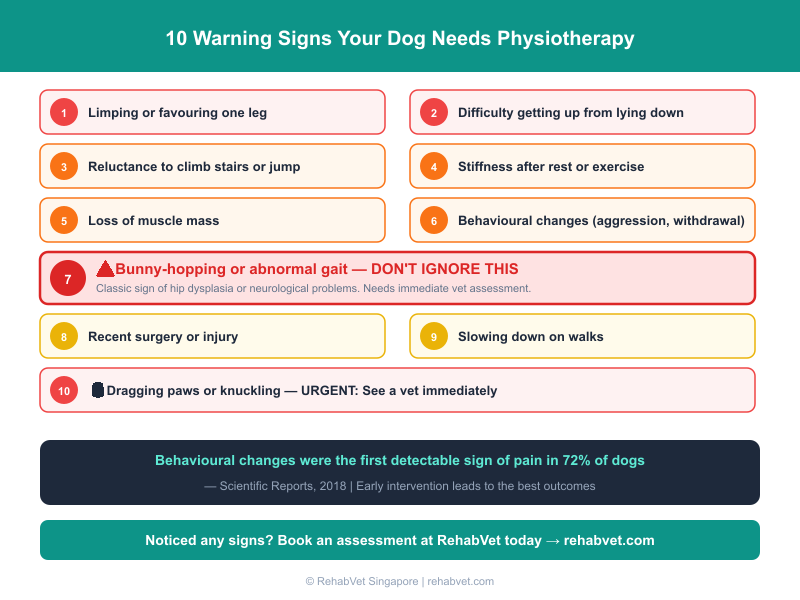
This is the one you really shouldn’t ignore.
Bunny-hopping — both hind legs moving together in a hopping motion instead of alternating — is a classic red flag for orthopaedic or neurological problems. Other weird gait patterns to watch for:
– Swaying or wobbling when walking, especially in the back end
– Crossing legs — one foot stepping in front of the other
– Short, choppy steps — not fully extending the limbs
– Circumducting — swinging a leg out to the side instead of moving it straight
– Crab-walking — the body angled to one side while moving forward
In young dogs (under 2 years), bunny-hopping often means hip dysplasia — a developmental condition that only gets worse without treatment. In older dogs, it can signal bilateral joint disease or neurological issues.
We flagged this as the one to never ignore because owners so often dismiss it. “Oh, that’s just how he runs.” “She’s always done that.” But healthy dogs should have a smooth, alternating gait. Any persistent deviation from that deserves investigation.
A dog diagnosed with hip dysplasia at 1 year and started on physio has a much better long-term outlook than one diagnosed at 5 with advanced joint damage. Early matters.
Physio for gait problems focuses on:
– Gait retraining — specific exercises that encourage normal movement patterns
– Muscle strengthening — building up the muscles around affected joints
– Pain management — reducing the discomfort driving compensatory movement
– Proprioceptive training — improving body awareness and coordination
If your dog bunny-hops, get it checked. Contact RehabVet to schedule an evaluation.
—
If your dog just had orthopaedic surgery — TPLO, TTA, femoral head ostectomy, fracture repair, spinal surgery — physio isn’t a nice-to-have. It’s a must.
Surgery fixes the structure. But it doesn’t restore function. After surgery, your dog deals with:
– Pain and swelling — which limit movement
– Muscle loss — from restricted activity
– Scar tissue — which can restrict range of motion if you don’t manage it
– Bad movement habits — compensations they developed before surgery that stick around after
– Lost confidence — genuine fear of using the operated limb
Research in Veterinary Surgery showed that dogs receiving physiotherapy after surgery got back to full weight-bearing 3 to 6 weeks earlier than those just given rest. That’s a huge difference.
| Phase | Timeframe | Focus |
|---|---|---|
| Acute | Days 1-14 | Pain management, gentle range of motion, ice therapy |
| Subacute | Weeks 2-6 | Progressive strengthening, introducing hydrotherapy |
| Rebuilding | Weeks 6-12 | Active strengthening, gait retraining, building endurance |
| Maintenance | Month 3+ | Return to normal activity, ongoing wellness exercises |
The best results come from starting physio within 48 to 72 hours post-surgery (or whenever your surgeon gives the green light). Early intervention prevents complications and gets your dog on the fastest track to recovery. We can’t stress this enough.
—
Remember when your dog practically dragged you down the street? Now they lag behind, plonk down on the pavement, or want to turn home after five minutes. A lot of owners put this down to “just getting old.” But age alone doesn’t explain a significant drop in exercise tolerance.
– Pain — the most likely reason. They’re uncomfortable and conserving energy
– Heart or breathing issues — limiting stamina (see your vet to rule this out)
– Muscle weakness — they just can’t sustain the effort
– Joint disease — especially arthritis affecting multiple joints
– Overheating — and in Singapore, this is a real factor
With average temperatures of 27-32°C and humidity that hits you like a wall, our dogs are already working harder just to stay cool. Add pain or joint problems on top of that, and walks become genuinely miserable for them.
This is one reason hydrotherapy works so well here. The temperature-controlled water lets dogs exercise in comfort regardless of what’s happening outside. No heat stress, no sweaty pavement.
Instead of just accepting shorter walks, a physiotherapist can:
– Figure out what’s limiting your dog — pain? Weakness? Something else?
– Build an exercise programme that gradually increases endurance without causing setbacks
– Suggest environmental changes — walking during cooler hours, picking shaded routes, using cooling vests
– Track progress — measuring distance and duration improvements over time
—
If your dog is scuffing the tops of their paws along the ground or knuckling over (standing on the top of the foot instead of the pads), pay attention. This is neurological.
Paw dragging and knuckling mean there’s a problem with proprioception — your dog’s sense of where their feet are in space. Possible causes:
– IVDD — disc herniation compressing the spinal cord
– Degenerative myelopathy — progressive spinal cord disease
– Lumbosacral disease — nerve compression at the base of the spine
– Brain lesions — rarely, tumours or strokes
Knuckling is always urgent. If your dog suddenly starts dragging their paws, see a vet that day. Neurological conditions can escalate fast, and early treatment makes a massive difference to outcomes.
For dogs with confirmed neurological conditions, physiotherapy is vital for:
– Preserving what function remains — targeted exercises to prevent further decline
– Retraining nerve pathways — proprioceptive exercises that help rebuild neural connections
– Building compensatory strength — strengthening unaffected limbs and core
– Preventing secondary problems — pressure sores, muscle contractures, weight gain
—
Spotted one (or more) of these in your dog? Here’s a practical plan:
Get a proper diagnosis first. Your vet may want X-rays, blood work, or advanced imaging (MRI/CT) to identify what’s going on underneath.
Once you have a diagnosis, bring up rehabilitation. Plenty of vets in Singapore now refer to specialised rehab centres like RehabVet for physio.
A thorough assessment by a certified rehab practitioner will uncover all the physical issues contributing to your dog’s symptoms — not just the headline diagnosis. That broader view leads to better results.
Physio works best when you’re consistent. Come to scheduled sessions and — this part’s important — do the prescribed home exercises between visits. Your commitment directly affects your dog’s outcome.
Note your dog’s activity levels, pain signs, and improvements day by day. Share this with your physiotherapist. It helps us fine-tune the treatment plan in ways we couldn’t otherwise.
—
Definitely. Young dogs with developmental conditions like hip dysplasia or luxating patella, sporting injuries, or post-surgical recovery all benefit from early physio. Starting young can prevent minor problems from snowballing as the dog ages.
Most owners notice changes within 2 to 4 sessions — especially with pain levels and willingness to move. Bigger functional improvements (muscle rebuilding, return to normal activity) usually take 6 to 12 weeks of consistent work.
Sometimes, yes — particularly for older dogs who aren’t great candidates for anaesthesia, or dogs with mild to moderate conditions. But for severe structural problems (complete ligament tears, unstable fractures), surgery is usually necessary, and physio becomes a key part of post-op recovery.
Not at all. We treat senior dogs regularly, and many show remarkable improvement. The goals might shift from “cure” to “comfort and quality of life,” but the impact can be profound. We’ve had 14-year-old dogs go from needing to be carried to walking on their own again.
Absolutely — and we often recommend it. At RehabVet, we take a multimodal approach that might combine physio with acupuncture, laser therapy, and other treatments for the best possible results.
—
Catching the signs your dog needs physiotherapy early can mean the difference between a quick recovery and a drawn-out, worsening problem. Dogs are tough — they won’t complain until the pain is really bad. It’s on us to read the subtle signals and act.
If you’ve noticed any of these 10 signs — a slight limp, reluctance to jump, that distinctive bunny-hop — don’t sit on it. Early intervention gets the best results, and veterinary physiotherapy has the evidence behind it to make a real difference.
Ready to take the first step? Book a physiotherapy assessment at RehabVet or message us on WhatsApp. We’ll listen, assess your dog properly, and put together a plan to get them moving comfortably again.
—
Written by the RehabVet clinical team. Last updated: March 2026.
RehabVet Clinical Team
Veterinary Rehabilitation Specialists, Singapore
RehabVet is Singapore's first and leading dedicated veterinary rehabilitation clinic, located at 513 Serangoon Road. Our team includes certified rehabilitation practitioners (CCRP), acupuncture-certified veterinarians, and hydrotherapy specialists. Meet our team →