
Every electrotherapy session is performed by a qualified rehabilitation therapist with specific training in electrode placement, parameter selection, and patient monitoring. This isn't a machine left running on a timer — it's clinical therapy actively managed by an expert.
Our electrotherapy devices offer precise control over frequency, pulse width, intensity, waveform, and duty cycle — parameters that consumer-grade units lack. The difference between therapeutic and sub-therapeutic stimulation is in the parameters.
Electrotherapy works best as part of a comprehensive programme. At RehabVet, your dog can receive electrotherapy, manual therapy, laser therapy, acupuncture, hydrotherapy, and HBOT — all in one visit, all coordinated by one team.
Many clinics focus exclusively on dogs. RehabVet has extensive experience treating cats as well — adapting protocols for feline sensitivity, temperament, and anatomy.
Real outcomes from real pet owners. Our results speak — and our reviews reflect the quality of care across all modalities, including electrotherapy as part of comprehensive rehabilitation programmes.
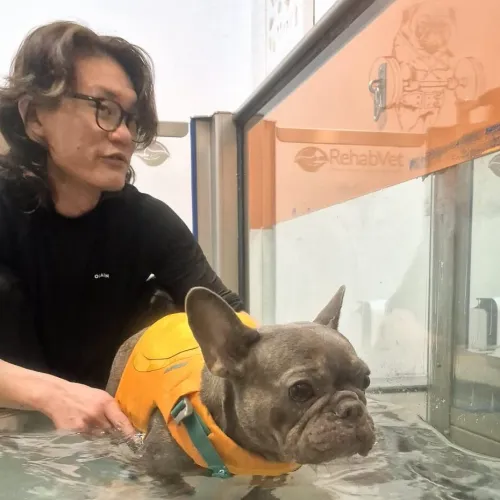
After surgery, during a spinal condition, or while living with arthritis, your dog faces two compounding problems: pain that discourages movement, and muscle atrophy that accelerates when movement stops. Pain medication masks symptoms but doesn’t rebuild what’s been lost.
Electrotherapy breaks both cycles simultaneously. TENS delivers non-pharmaceutical pain relief by flooding nerve pathways with signals that block pain transmission and triggering endorphin release. NMES causes controlled muscle contractions — strengthening muscles and preventing atrophy even when your dog cannot or will not move voluntarily.
TENS — Transcutaneous Electrical Nerve Stimulation: Targets sensory nerves for pain relief and muscle relaxation. Gentle tingling sensation — most dogs relax or sleep. 10–20 minutes per treatment site.
NMES — Neuromuscular Electrical Stimulation: Targets motor nerves and skeletal muscles for strengthening and re-education. Visible rhythmic muscle contractions. 15–25 minutes per muscle group.
In many rehabilitation programmes, both TENS and NMES are used in the same session — TENS first for pain relief, then NMES for active muscle work.

Your therapist assesses the target area — identifying specific muscles, nerve pathways, and pain points. The treatment site is clipped (if needed) and cleaned. Small adhesive electrodes are placed at precise anatomical locations. Electrode placement is critical — it determines which nerves or muscles receive stimulation.
If pain management is needed, TENS is applied first. The device starts at the lowest intensity and gradually increases. Most dogs settle quickly as the gentle tingling takes effect. Within minutes, endorphin release begins and pain signals are dampened. Treatment lasts 10–20 minutes per site. Many dogs visibly relax and some fall asleep.
If muscle work is needed, NMES follows. You'll see rhythmic muscle contractions — a contraction phase (5–10 seconds) followed by a rest phase (10–20 seconds). The therapist monitors each contraction and adjusts intensity to achieve optimal muscle activation. Treatment lasts 15–25 minutes per muscle group.
Electrodes are removed and the skin is checked. Your therapist may follow electrotherapy with manual therapy while muscles are warm and relaxed, laser therapy for additional anti-inflammatory effect, or exercises to build on the muscle activation achieved. Progress is recorded and the plan adjusted.
Session notes recorded, progress measurements taken at regular reassessments, and home exercise recommendations provided where appropriate.
WhatsApp us at +65 8798 7554 to discuss your dog’s needs and schedule an assessment.
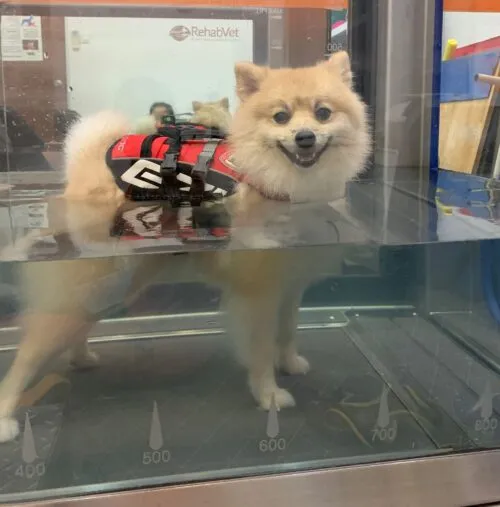
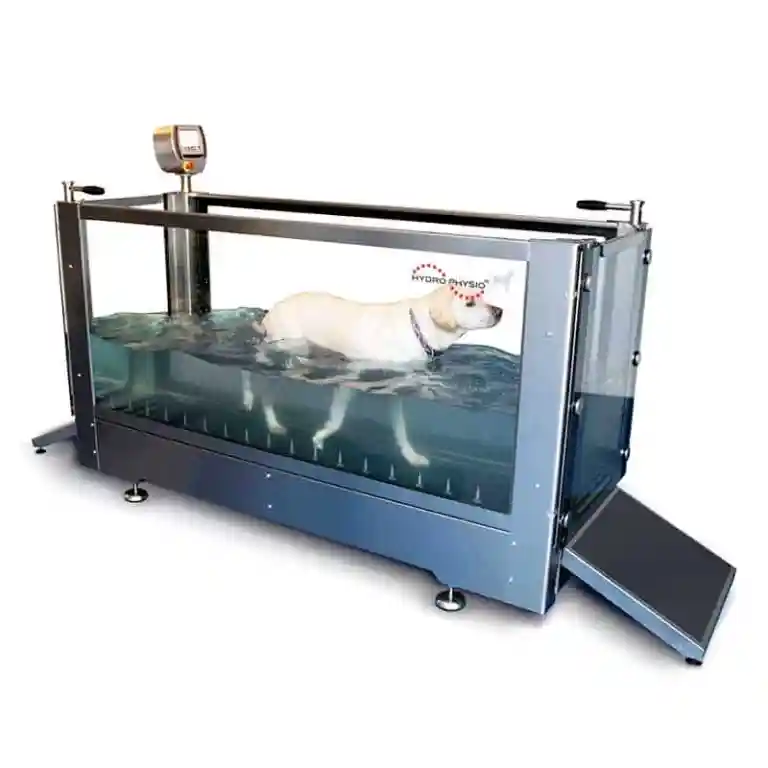
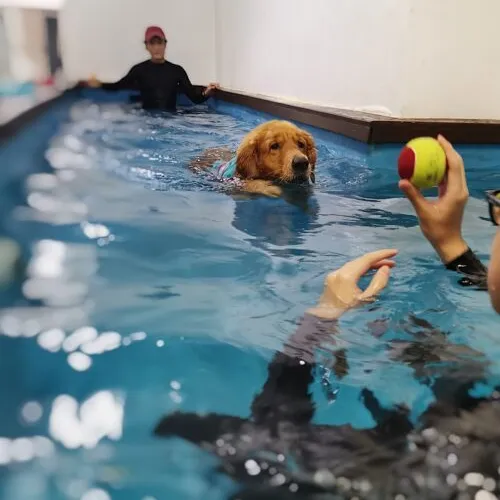
Water buoyancy reduces your dog's effective body weight by up to 60–90%, allowing movement and muscle activation without stressing damaged or post-surgical joints. This makes hydrotherapy safe during recovery phases when land exercise would be harmful.
Dogs recovering from TPLO, TTA, fracture repair, or spinal surgery typically regain full weight-bearing 30–40% faster with hydrotherapy as part of their programme. The water environment enables controlled movement before the patient is ready for land-based exercise.
Warm water (28–32°C) promotes vasodilation, reduces joint stiffness, and triggers the release of endorphins. Many dogs show immediate reductions in pain scores after their first session, particularly those with chronic arthritis or degenerative joint disease.
Water provides 12–14 times more resistance than air, making each movement more effective for muscle building. This is critical for dogs with muscle atrophy following injury, surgery, or neurological conditions — and for senior dogs losing muscle due to age.
For dogs with IVDD, degenerative myelopathy, or other neurological conditions, the sensory feedback from water contact and the supported movement environment helps retrain neural pathways and improve motor function over time.
Hydrotherapy burns significantly more calories than equivalent land exercise due to water resistance, without the joint impact that makes conventional exercise difficult for overweight dogs. Combined with dietary management, it's one of the most effective weight loss tools in veterinary rehabilitation.
The resistance of water provides an effective cardiovascular workout at lower speeds and intensities than land-based exercise. This is especially valuable for dogs who cannot exercise at normal intensity due to orthopaedic or respiratory conditions.
The warmth and buoyancy of water allow joints to move through a fuller range of motion with less pain. Clinical measurements at RehabVet show joint range of motion improvements of 15–25% within 4–6 sessions for many arthritis patients.
Many dogs develop a positive association with hydrotherapy sessions, particularly when introduced gradually using our low-stress handling approach. The combination of physical improvement and positive experience supports overall wellbeing during difficult recovery periods.
Unlike most exercise modalities, hydrotherapy sessions at RehabVet are accompanied by regular reassessments — muscle circumference measurements, gait analysis, and functional mobility scoring — so you can see your dog's progress in concrete terms.
TENS
The most common application. TENS provides non-drug pain relief for arthritic joints, allowing dogs to move more comfortably. Regular sessions reduce reliance on pain medication. Particularly valuable for senior dogs where long-term NSAID use carries organ risks.

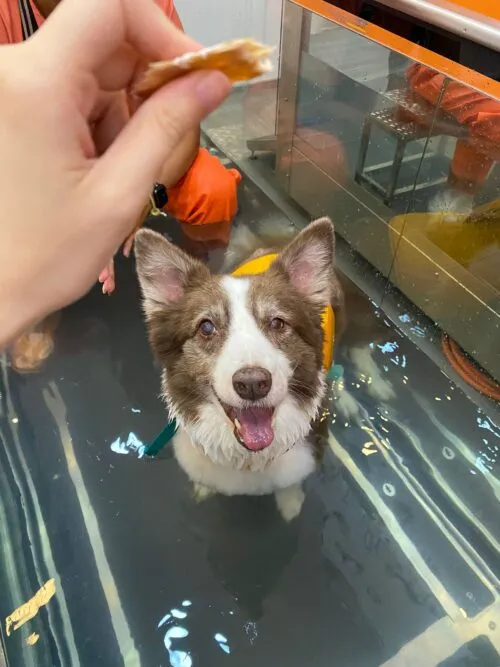
Dogs recovering from TPLO, TTA, femoral head ostectomy (FHO), fracture repair, or spinal surgery benefit enormously from early hydrotherapy. We coordinate with your primary vet to begin sessions as soon as it is safe to do so — typically 10–14 days post-surgery once wound closure is confirmed.
Arthritis is the most common reason dogs are referred for hydrotherapy in Singapore. The warm water environment significantly reduces joint pain and stiffness, allowing dogs with severe arthritis to exercise safely and maintain the muscle mass that supports joint health. Read more about arthritis treatment.
IVDD patients — particularly Dachshunds, French Bulldogs, and Corgis — often present with hind limb weakness, ataxia, or paralysis. Hydrotherapy provides a supported environment for these dogs to work on strengthening and neural retraining, often alongside laser therapy and physiotherapy.
Dysplastic joints cause lifelong pain and progressive degeneration. Regular hydrotherapy sessions help dysplastic dogs maintain muscle mass around affected joints, reducing the load on dysplastic surfaces and slowing disease progression significantly.
Degenerative myelopathy, fibrocartilaginous embolism (FCE), and other neurological conditions affecting mobility respond well to the sensory stimulation and supported movement hydrotherapy provides. Progress can be slow but is often meaningful and measurable.
Obese dogs carry significantly elevated risk of orthopaedic disease, diabetes, and reduced life expectancy. Hydrotherapy enables effective calorie-burning exercise without the joint stress that makes conventional exercise painful or unsafe for overweight dogs.
Older dogs benefit from regular hydrotherapy as a maintenance programme — preserving muscle mass, joint mobility, and cardiovascular fitness as they age. Many of our senior patients come fortnightly or monthly for ongoing wellness sessions, not acute treatment.
Both pre- and post-surgical cruciate cases benefit from hydrotherapy. Pre-surgical: to maintain muscle mass and fitness. Post-surgical: to accelerate recovery and restore normal gait patterns. The underwater treadmill is particularly effective for cruciate cases because it promotes weight-bearing walking, unlike pool swimming.
TENS relaxes painful muscles and reduces guarding, allowing the therapist to perform deeper, more effective manual therapy. NMES can then strengthen muscles through the improved range of motion that manual therapy created. Particularly powerful for spinal conditions and joint stiffness.
TENS before a treadmill session reduces pain, allowing more comfortable and higher-quality movement in the water. NMES after hydrotherapy targets specific muscles that need additional strengthening. Dogs move better in water when they arrive pain-free.
Class 4 laser and TENS both provide pain relief through different mechanisms — laser reduces inflammation at the cellular level while TENS blocks pain signal transmission. Used together, the analgesic effect is additive. Laser also accelerates tissue healing, complementing NMES's muscle-rebuilding effects.
TENS and/or NMES, 15–30 min
Electrotherapy + manual/laser
Electrotherapy + hydro/multi-modal
| Feature | Underwater Treadmill (RehabVet) | Swimming Pool |
|---|---|---|
| Water depth control | Yes — adjustable to the centimetre | No — fixed depth |
| Speed control | Yes — variable treadmill speed | No — depends on the dog |
| Suitable for non-swimmers | Yes | No |
| Weight-bearing exercise | Yes — promotes natural gait | Limited — swimming is non-weight-bearing |
| Post-surgical rehab | Excellent — controlled, safe movement | Risky — hard to control movement |
| Gait retraining | Yes — treadmill encourages normal walking | No |
| Muscle building | Targeted — resistance + walking gait | General — swimming uses different muscles |
| Best for | Surgery recovery, arthritis, IVDD, neurological rehab | General fitness, cardiovascular conditioning |

EXCELLENTTrustindex verifies that the original source of the review is Google. We’ve been bringing Kuma to RehabVet for physiotherapy and the experience has been outstanding. The team truly cares for every fur patient, and you can feel the warmth and dedication the moment you walk in. A special thank you to Hazel, Kuma’s therapist, who is incredibly patient, attentive, and knowledgeable. She not only conducts the sessions with great care but also provides practical advice for us to continue strengthening Kuma’s muscles at home and the results really show. The reception team is always friendly and accommodating, making scheduling easy and stress-free. Thank you as well to Dr. Sara, Xan, and the entire RehabVet team for the love and professionalism you show to every pet. If your furkid needs rehabilitation or physiotherapy, RehabVet is truly a place you can trust. Kuma is in the best hands here!Posted onTrustindex verifies that the original source of the review is Google. The staff have a genuine concern over our beloved Snowy. Despite her advance age, they are gentle with her and tries to give a thorough update with suggestions on improving her conditions. Thankful for such care.Posted onTrustindex verifies that the original source of the review is Google. Bubble has been with Rehab Vet for years as he grows older and manages his luxating patella. I am truly grateful to Doc Sara, Xan, Sean, Joyce, and the entire rehab team for always taking such wonderful care of Bubble and watching over him during every session. Bubble came from a condition whereby he couldn’t even walk, he was paralysed. But really thankful to rehab vet that made the impossible, became possible. Thank you Doc Sara & all Rehab TeamPosted onTrustindex verifies that the original source of the review is Google. Excellent staff who are compassionate, loving, caring and attentive to my furry senior dog. The pain management and care tips really helped the mobility of my senior dog.Posted onTrustindex verifies that the original source of the review is Google. As a fur mummy, finding people who genuinely care for and love our babies is so important. I’ve found exactly that here, especially with Judette, Xan, Noelle, and Joyce. My babies, Barley (17yo cat) and Lexi (9yo dog), come in for pain management and rehab sessions, and I’m always completely comfortable with how they’re treated. The team is incredibly patient, gentle, and kind, and it shows in the way they handle my pets. So grateful to have found a rehab centre I truly trust. Highly recommended.Posted onTrustindex verifies that the original source of the review is Google. Excellent rehabilitation care for my Shih Tzu Tooblik. Dr Sara Lam n the therapists at RehabVet are both expert n kind. Tooblik was able to move better n lift his head up again, thank you for the care n treatment to let my furry family member feels better n on the route to recovery.Posted onTrustindex verifies that the original source of the review is Google. My dog has been having his rehab here ever since his FPO surgery. The therapists were very patient and experienced in handling his temperament and pain. I come each time knowing he is in safe and experienced hands. My dog has been recovering faster than expected and his mobility improved so much after just 2 months.Posted onTrustindex verifies that the original source of the review is Google. My husband and I are extremely grateful to the staff at Rehab vet. From our first enquiry to therapy, the different staff members we've encountered were friendly, informative and so gentle with my dog. Special mention, Hazel and Sean who were Cassie's therapists. Thank you to all staff at ReHab Vet.Verified by TrustindexTrustindex verified badge is the Universal Symbol of Trust. Only the greatest companies can get the verified badge who has a review score above 4.5, based on customer reviews over the past 12 months. Read more
No. TENS produces a gentle tingling sensation — most dogs relax and many fall asleep during treatment. NMES causes visible muscle contractions that may feel unusual initially, but are not painful. Our therapists start at the lowest settings and gradually increase, monitoring your dog’s comfort throughout. Sessions are always adjusted to your pet’s tolerance.
This depends on the condition. Acute post-surgical cases may need 6–12 sessions over 3–6 weeks. Chronic conditions like arthritis often benefit from ongoing sessions — weekly during active treatment, reducing to fortnightly or monthly for maintenance. Your therapist will design a treatment plan based on your dog’s specific condition and response.
Consumer-grade TENS units exist, but professional guidance is strongly recommended. The effectiveness of electrotherapy depends on correct electrode placement, parameter selection, and real-time adjustments. Incorrect placement can miss the target nerve or muscle entirely. At RehabVet, we may recommend home TENS for certain patients after proper training.
Electrotherapy is safe for most dogs. Contraindications include: active cancer (over tumour sites), pregnancy, pacemakers, open wounds or infected skin at the treatment site, and seizure disorders. Your therapist will perform a thorough assessment before treatment to ensure electrotherapy is appropriate for your pet.
TENS targets sensory nerves for pain relief — it blocks pain signals and triggers endorphin release. NMES targets motor nerves to cause muscle contractions — it strengthens muscles and prevents atrophy. They serve different purposes and are often used together in the same session: TENS first for pain, then NMES for strength.
In some cases, electrotherapy can reduce or eliminate the need for pain medication. TENS provides effective non-pharmaceutical pain relief through nerve signal blocking and endorphin release. However, this should always be discussed with your veterinarian — electrotherapy is best used as part of a multimodal approach, not as a unilateral replacement for prescribed medication.
A typical session lasts 30–45 minutes. TENS treatment is 10–20 minutes per site, and NMES is 15–25 minutes per muscle group. If both are used in the same session, total treatment time is longer. Sessions that include other modalities (manual therapy, laser) may take 60–90 minutes in total.
Yes. RehabVet has extensive experience treating cats with electrotherapy. Feline protocols use adapted parameters — lower intensities, shorter durations, and finer electrode placement suited to cats’ smaller anatomy and sensitivity. Cats with arthritis, post-surgical pain, and neurological conditions respond well to both TENS and NMES.
Most dogs show noticeable improvement within 2–4 sessions. TENS provides immediate pain relief — often visible during the first session (relaxation, reduced guarding). NMES results take longer — measurable muscle mass increases typically appear after 2–3 weeks of regular sessions. Combined with other rehabilitation modalities, electrotherapy significantly accelerates recovery timelines.
No referral is needed. You can book a rehabilitation consultation directly. During the initial assessment, our team will determine whether TENS, NMES, or both are appropriate for your pet’s condition, and design a comprehensive treatment plan.
Yes — electrotherapy is particularly valuable for IVDD and other neurological conditions. TENS manages the significant pain component, while NMES maintains and rebuilds muscle that would otherwise waste during the recovery period. For dogs with reduced voluntary motor function, NMES provides stimulus that damaged nerves cannot, preventing atrophy while nerve recovery occurs.
At RehabVet, electrotherapy-only sessions cost $60–$90 (TENS and/or NMES, 15–30 minutes). Combined sessions with manual therapy or laser cost $90–$150. Full rehabilitation sessions with hydrotherapy and multiple modalities cost $120–$180. Package rates are available for multi-session treatment plans. Contact us for a personalised quote.