
Total Hip Replacement Recovery
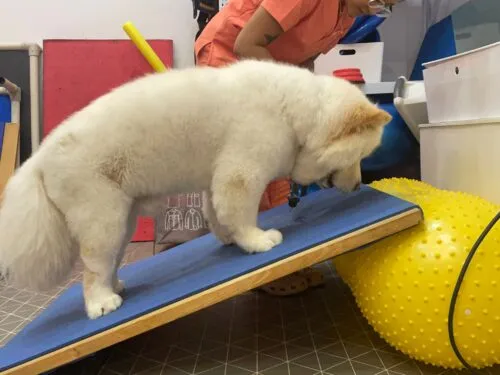
This page is for educational purposes only and is not a substitute for veterinary diagnosis or emergency care. Always consult your primary veterinarian or a rehabilitation veterinarian before starting treatment. If your pet cannot walk, has sudden paralysis, severe pain, or breathing difficulty, seek urgent veterinary attention.
What is Total Hip Replacement Recovery?
Also known as: THR recovery; hip arthroplasty rehab; prosthetic hip recovery.
Total hip replacement replaces the diseased femoral head and acetabulum with prosthetic components, aiming for pain relief and near-normal hip mechanics in carefully selected dogs (and occasionally cats). Success depends on surgical technique, implant stability, infection prevention, and owner compliance with activity restriction.
Post-operative rules are typically stricter than FHO regarding jumping, play, and uncontrolled motion during early osseointegration/soft-tissue healing. Physiotherapy must never conflict with the surgeon’s dislocation precautions and radiographic follow-up schedule.
Within those constraints, rehab reduces muscle loss, maintains safe range, improves proprioception, and guides a gradual return to leash walks and, eventually, more normal activity when cleared.
What are the signs of Total Hip Replacement Recovery?
Signs vary by severity and by whether your pet is a dog or cat. Owners of dogs and cats often notice:
- Recent or planned total hip replacement
- Need for structured confinement and sling-assisted walking
- Muscle atrophy during the protected period
- Uncertainty about allowed range-of-motion exercises
- Compensatory stiffness in the lumbar spine or opposite limb
- Desire for a clear staged return-to-activity roadmap
What causes Total Hip Replacement Recovery?
- Major joint replacement surgery requiring implant protection
- Prescribed confinement causing disuse atrophy
- Pre-operative chronic pain and muscle loss from hip dysplasia/OA
- Altered gait habits learned over months of discomfort
- Soft-tissue healing around the new joint
How can veterinary rehabilitation help with Total Hip Replacement Recovery?
Therapists coordinate directly with surgeon protocols: which motions are allowed, when swimming starts, and how quickly walk duration increases.
Early work may emphasise swelling control, careful assisted standing, and approved ROM. Later phases add strengthening and underwater treadmill under clearance.
Owners learn dislocation-risk activities to avoid (e.g., unrestrained play, slippery floors, jumping into cars) until released.
Rehabilitation plans at RehabVet are individualised after a veterinary assessment. We coordinate with your primary vet when imaging, medication, or surgery is part of the overall plan.
Which therapies may be used for Total Hip Replacement Recovery?
Depending on your pet’s examination findings, comfort, and goals, a plan may include one or more of the following:
What are the rehabilitation goals for Total Hip Replacement Recovery?
Goals are set for the individual patient. Typical aims may include (not guarantees — outcomes vary):
- Protect implant stability while controlling post-operative discomfort
- Maintain allowable hip motion and soft-tissue health
- Rebuild gluteal and thigh strength on a delayed, safe schedule
- Restore functional gait for daily pet life
- Support long-term joint care and weight management
We do not publish invented success percentages. Progress is tracked clinically (gait, strength, range of motion, pain behaviours, and home function) and plans are adjusted over time.
When should you seek veterinary care for Total Hip Replacement Recovery?
- Any suspicion of dislocation (sudden non-use, limb carriage change) — emergency surgical contact
- Incision infection signs or systemic illness
- Before starting any exercise beyond the written discharge sheet
- If your pet becomes acutely painful months later — implant evaluation needed
No. FHO often emphasises earlier aggressive limb use; THR prioritises implant protection with more conservative early loading. Always follow the THR surgeon’s protocol.
Usually only after the surgeon clears higher-impact activity — often months, not weeks. Use ramps meanwhile. Exact timing is individual.
Less commonly than dogs, but it is performed in selected cases. Rehab principles still apply with feline-friendly handling and environment setup.
Related reading & patient stories
Book a rehabilitation assessment
If your pet has been diagnosed with THR recovery, or you are noticing mobility changes, our team can assess and design a multimodal rehab plan.
Educational content only — not a diagnosis. For emergencies, contact your nearest veterinary hospital.
Related Conditions
- ConditionFHO RecoveryFHO (femoral head and neck ostectomy) removes the femoral head to alleviate hip pain. Rehabilitation is essential to form a functional pseudoarthrosis and rebuild muscle.Learn more
- ConditionFracture RecoveryFracture recovery combines surgical or external fixation healing with rehabilitation to restore joint motion, muscle, and confident weight-bearing in dogs and cats.Learn more
- ConditionPatella Surgery RecoveryPatella surgery recovery follows correction of kneecap luxation. Rehabilitation restores quadriceps function, stifle control, and graded return to jumping and play.Learn more