Getting a Dog Who Cannot Walk to the Vet in Singapore
The hard part is the front door, not the app
A pet taxi Singapore owners book from the sofa still has to get a dog who cannot stand through the lift and into a vehicle. That is the step that goes wrong. The driver arrives, sees a large dog on a board, and the job changes. Start by being honest in the booking about the dog's weight, whether they can walk at all, and whether they will be on a stretcher or a firm mattress. A surprise at the kerb helps nobody, including the dog who is then left waiting in the lobby.
If the weakness, paralysis or neck pain started today, do not shop for the calmest transport to a routine appointment tomorrow. Go to an emergency vet now. A disc, a clot in a cat, a fracture or a poisoning will not improve while you compare apps. Use the same careful carry, and choose the hospital that can see an emergency, not the clinic with the most convenient slot. RehabVet is not the first stop for a dog who has just collapsed. Phone an emergency clinic first.
What to confirm before the car arrives
GrabPet is one option inside the Grab app for travelling with pets. Confirm in the app, on the day, that a driver will accept a dog who cannot walk, a large breed, or a dog on a board. Do not rely on a memory of how the service worked last year. We will not invent a fare or a size limit. Fares and rules change, and a driver can still cancel when they see the situation. Have a second plan. Have a person with you who can lift. A booking confirmation is not a second pair of hands.
Private pet transport companies exist alongside ride-hailing. Ask whether they carry a ramp, whether two people travel with the vehicle, and whether they will wait at the clinic or only do a kerb drop. Ask what they refuse. Some will not take a dog who is incontinent, aggressive, or too large for one handler. That refusal is better heard on the phone than at your void deck. If they cannot describe how they keep a paralysed dog from sliding when the car brakes, choose someone else or use your own car.
Your own car is often the safer plan
If you can lift the dog, your own car is usually calmer. There is no stranger, no cancellation, and you control the air-conditioning. Put a non-slip mat or a firm mattress on a flat seat or, for a dog who must stay level, in a space where the spine does not bend over a hump. A person sits beside them. Air-conditioning goes on before the dog gets in. Do not leave them loose in a footwell or in a closed boot. A boot can overheat, and a loose dog will slide into the seatbacks at the first traffic light on Serangoon Road.
A dog who can sit without pain can wear a harness clipped to a proper seatbelt attachment, not a collar. A dog in spinal pain or paralysis should not be propped into a sit to make the seatbelt look correct. Flat is safer. Towels manage urine. Bring more than you think. A wet, slipping dog is harder to unload than a dry one. Park where you can open the door fully. Parallel heroics on a busy road are how people drop the hindquarters.
Want a vet to look at how your pet is moving?
A rehabilitation assessment looks at pain, gait and what should happen next. You leave with a plan, whether that is physiotherapy, hydrotherapy or a referral back to your own vet.
The lift itself
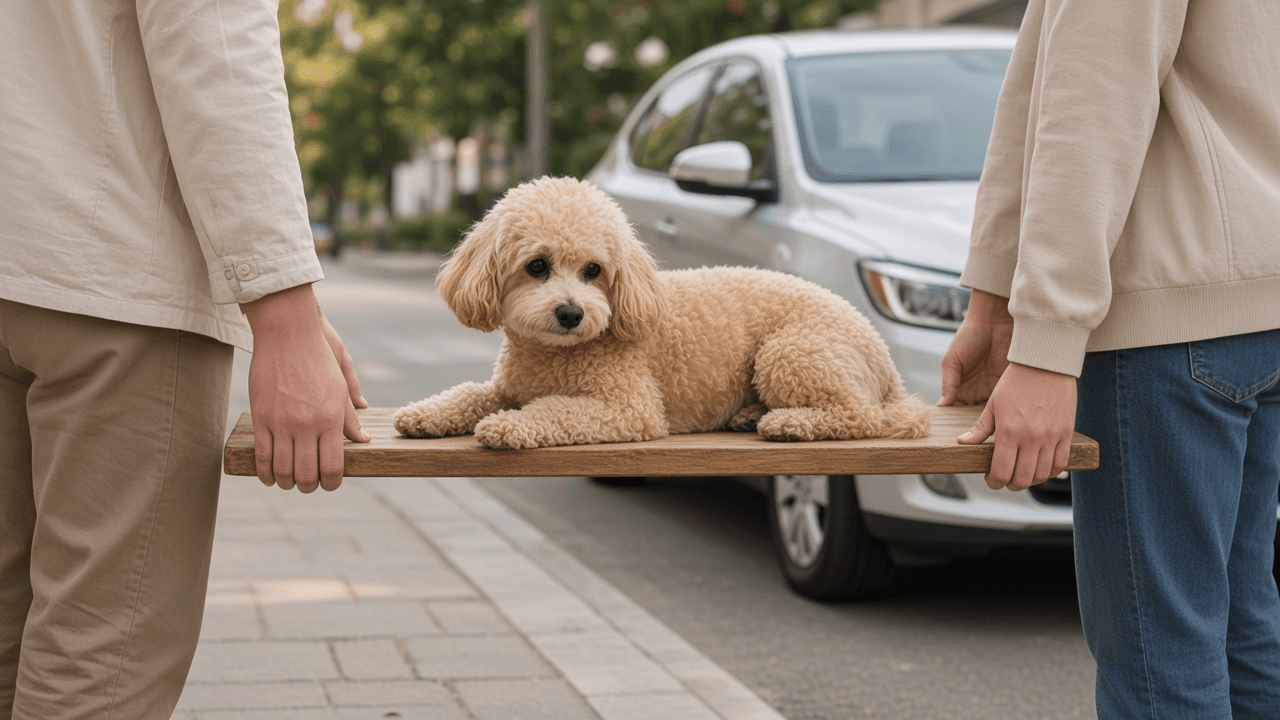
Support the chest and the pelvis so the spine stays level. Do not scoop the belly, do not dangle the back end, and do not lift by a harness handle alone if the back is the problem. Small dogs can be held against your chest by one person who is strong enough. Medium and large dogs need two people or a board. Slide rather than roll them when you can. On stairs, do not let them try even a few steps. Use the lift. If you are in a walk-up, rest on the landing with the dog still supported. Putting them down to scramble is the injury you were trying to avoid.
A towel sling is only for a short, supported stand when a vet has said the spine may bear that, and it is a poor carrying method because the middle sags. For the car, a board or a firm base beats a sagging blanket. Cover a frightened dog's eyes loosely if it calms them, without blocking breathing. Talk before you lift so a painful dog is not grabbed by surprise. If they thrash, stop and reset. A fall from your arms is worse than a slower departure. Phone the clinic and say you are delayed rather than rushing the transfer.
Cats in the same trip
A cat who cannot walk should travel in a carrier that opens from the top, lined with a towel, so nobody tips them out by the hind legs. Belts or a footwell brace should stop the carrier becoming a projectile. Cover it. Keep the car quiet. A cat with sudden back-leg paralysis, cold paws, open-mouth breathing or a possible poisoning needs an emergency vet, not a scheduled rehabilitation slot. Do not give paracetamol or Panadol. Those can kill a cat, and there is no safe home dose. If any was given, take the box with you.
Do not put a paralysed cat loose on a lap. They will dig in when the car moves, and you will grab whatever you can, which is how spines twist. If you are using a pet taxi, say it is a cat in a carrier who cannot walk, and ask whether the driver needs the carrier on a seat. Some vehicles have no safe flat space. Knowing that before they arrive saves a miserable negotiation downstairs. Bring a spare towel. Urine in a carrier is common when a cat is frightened or neurologically unable to posture.
Arriving at the clinic
Call ahead. For RehabVet, that number is +65 6291 6881, and the clinic is at 513 Serangoon Road. Tell us if the dog cannot walk so we can advise you on access rather than meet a carried dog at a difficult kerb with no warning. If you have been sent to an emergency hospital instead, follow that instruction. A rehabilitation doorway is the wrong destination for a first-day paralysis. Use the appointment page only for a planned visit, or book a planned assessment when the dog is stable enough that transport is a logistics problem rather than an emergency.
At the door, ask the clinic to bring a trolley if they have one, and do not let anyone pull your dog out by the lead. Offer the history while the dog is still supported. Mention tick exposure, trauma, human medicines, and whether urine has been passed. Those facts change triage. If you are going on afterwards to a fitness swim or a physiotherapy session on another day, the same transport rules apply. A supervised swim is not useful if the journey there has folded a sore back. Plan the ride home before you start the session, while everyone is still calm.
Heat, urine and the journey itself
Singapore traffic plus a panting, stressed dog in a poorly cooled car is a welfare problem on top of the original one. Cool the car first. Do not leave the dog inside while you dash back for a wallet. Bring water if they can drink safely lying down, and do not force it. If they vomit, keep the car moving towards the clinic unless they are collapsing, in which case phone the clinic and ask whether to divert to the nearest emergency door. Describe the breathing. Open-mouth breathing in a cat, or blue or brown gums in any pet, is an emergency you mention in the first sentence.
Incontinence is not a reason to wrap the dog in so many layers that they overheat. One absorbent pad under the hindquarters, and a change at the other end, is enough. Clean the skin when you arrive so urine does not scald. Tell the driver, if you are using a taxi, before they accept, not after the seat is wet. Hiding it gets you cancelled on the return trip, which is the trip people forget to plan. Book the return while you are at the clinic if the dog still cannot walk. Do not assume the same car will be free in an hour.
A checklist you can keep in the phone
Before you book: can the dog walk, what do they weigh, can they lie flat, are two people available, is this an emergency. Before the car arrives: air-conditioning on, mat or board ready, towels, the vet's address written down, human painkillers not given. During the lift: chest and pelvis supported, no belly scoop, no collar haul. On the way: one person beside the dog, phone number of the clinic on the screen. On arrival: do not unload until someone can help, and say if the legs failed today.
Planned rehabilitation transport can be orderly. Emergency transport should be orderly and fast. The difference is the destination and the clock, not the careful hands. If you are unsure which one you are in, phone and describe whether the dog could walk this morning. A dog who has been paralysed for a month and is due a review is a planned carry. A dog who was normal at breakfast and cannot stand at lunch is an emergency carry. Both deserve a level spine. Only one of them should be waiting for a cheaper ride.