Hyperbaric Oxygen Therapy for Pets in Singapore
How It Works, What It Treats, and What It Costs
Hyperbaric oxygen therapy (HBOT) has moved from human hospitals into mainstream veterinary care, and it’s now one of the tools we use most for serious spinal, neurological, and healing problems in pets. If your vet has mentioned it, or you’ve been searching for a way to help a dog or cat with a difficult condition, this page explains exactly what HBOT is, what it treats, what a session is like, what it costs in Singapore, and what we’ve learned from running it across hundreds of cases.
At our clinic, HBOT isn’t a novelty — we’ve delivered 899 sessions across 126 pets, dogs and cats, over several years. That real-world experience shapes everything below.
What is hyperbaric oxygen therapy?
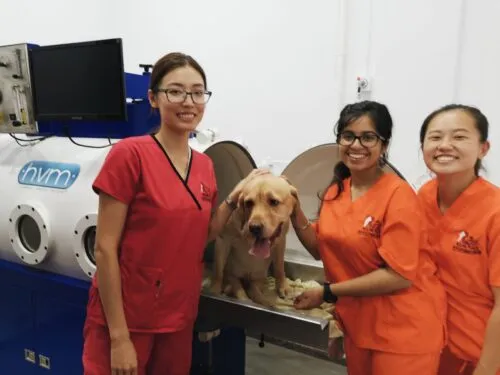
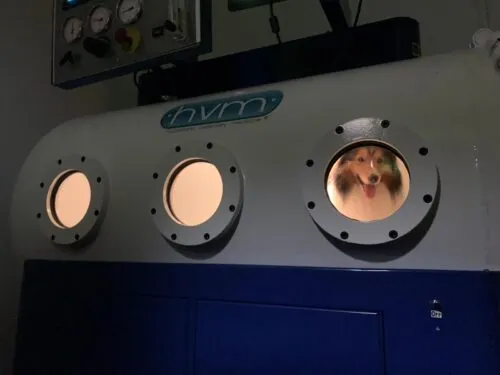
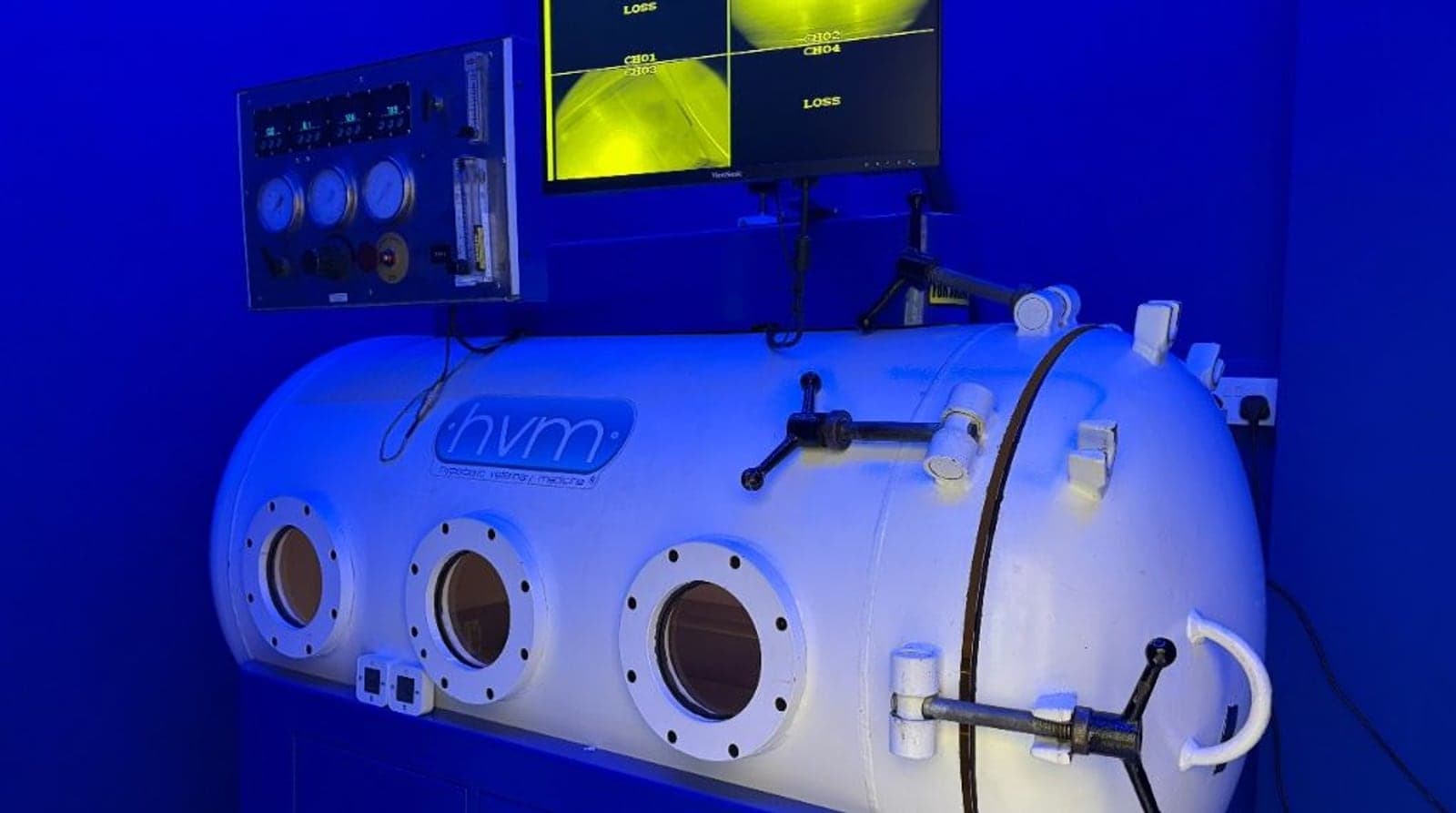
HBOT involves your pet resting inside a clear, pressurised chamber while breathing air with a high concentration of oxygen. The combination of raised pressure and high oxygen does something ordinary breathing can’t: it dissolves far more oxygen directly into the blood plasma, so oxygen can reach tissues that swelling, injury, or poor circulation are otherwise starving.
It is non-invasive, requires no sedation, and a typical session lasts around 30 to 60 minutes. Your pet simply rests — many sleep through it — while being monitored the whole time.
The core idea is simple: oxygen is the fuel for healing. Injured nerves, healing wounds, and recovering tissue all have a high oxygen demand at exactly the moment their blood supply is most compromised. HBOT helps close that gap.
What HBOT treats — based on real-world use
Rather than list every theoretical use, here’s what HBOT is actually used for, grounded in both the published evidence and our own caseload. In the largest published veterinary HBOT study to date — a retrospective analysis of 2,792 treatment sessions — two categories dominated: neurologic injuries (50.4%) and tissue healing (31.4%). Our own distribution looks very similar.
| Condition area | Examples we treat |
|---|---|
| Spinal / IVDD | Disc disease (IVDD), disc extrusions, spinal cord injury, post-spinal-surgery recovery. |
| Neurological recovery | Stroke (vascular events), vestibular disease, cerebral hypoxia, nerve injuries. |
| Post-surgery | Accelerating recovery and tissue healing after spinal or orthopaedic surgery. |
| Wounds & tissue healing | Non-healing wounds, post-surgical sites, and difficult skin or soft-tissue injuries. |
| Senior mobility | Supporting older pets with arthritis and reduced mobility as part of a wider plan. |
Want to go deeper on a specific condition? We have dedicated guides on IVDD recovery without surgery, speeding up recovery after surgery, weak hind legs, and stroke & vestibular disease.
What 899 sessions at RehabVet look like
Numbers from our own records give a realistic picture of who HBOT actually helps:
- 899 sessions across 126 pets — dogs and cats alike.
- Average patient age: 11.5 years — these are overwhelmingly senior pets with serious conditions.
- Spinal, neurological, and hind-leg weakness cases form the core — mirroring the published evidence on where HBOT helps most.
- Cats too — including neurological cases that almost no other local provider treats with HBOT.
One honest, important point: HBOT is almost never used alone. The best results come when it’s part of a structured rehabilitation plan — typically alongside hydrotherapy, physiotherapy, and home exercises. We’ll always be clear about what HBOT can and can’t contribute to your pet’s recovery.
How much does HBOT for pets cost in Singapore?
We believe in price transparency, so here is our full HBOT pricing. Many pets are treated in courses, which is why package pricing brings the per-session cost down.
| Option | Price | Per session |
|---|---|---|
| Single session (60 min) | S$380 | S$380 |
| 6-session package | S$2,039 | S$339.83 |
| 10-session package | S$2,759 | S$275.90 |
| Introductory session, 30 min, no consultation | S$152 | — |
| Introductory session with consultation (weekday / weekend) | S$315 / S$360 | — |
For context, veterinary HBOT in the US commonly runs from roughly US$125 to US$600 per session, so our pricing is competitive internationally. The easiest way to start is a rehabilitation assessment — so we can advise whether HBOT fits your pet before you commit to a package.
Is HBOT safe, and what does a session feel like?
HBOT has a strong safety record in veterinary use. In that same 2,792-session study, only minor adverse events were reported in a handful of dogs (agitation in two, vomiting in three), and serious complications were rare — consistent with HBOT’s well-established safety profile when properly supervised.
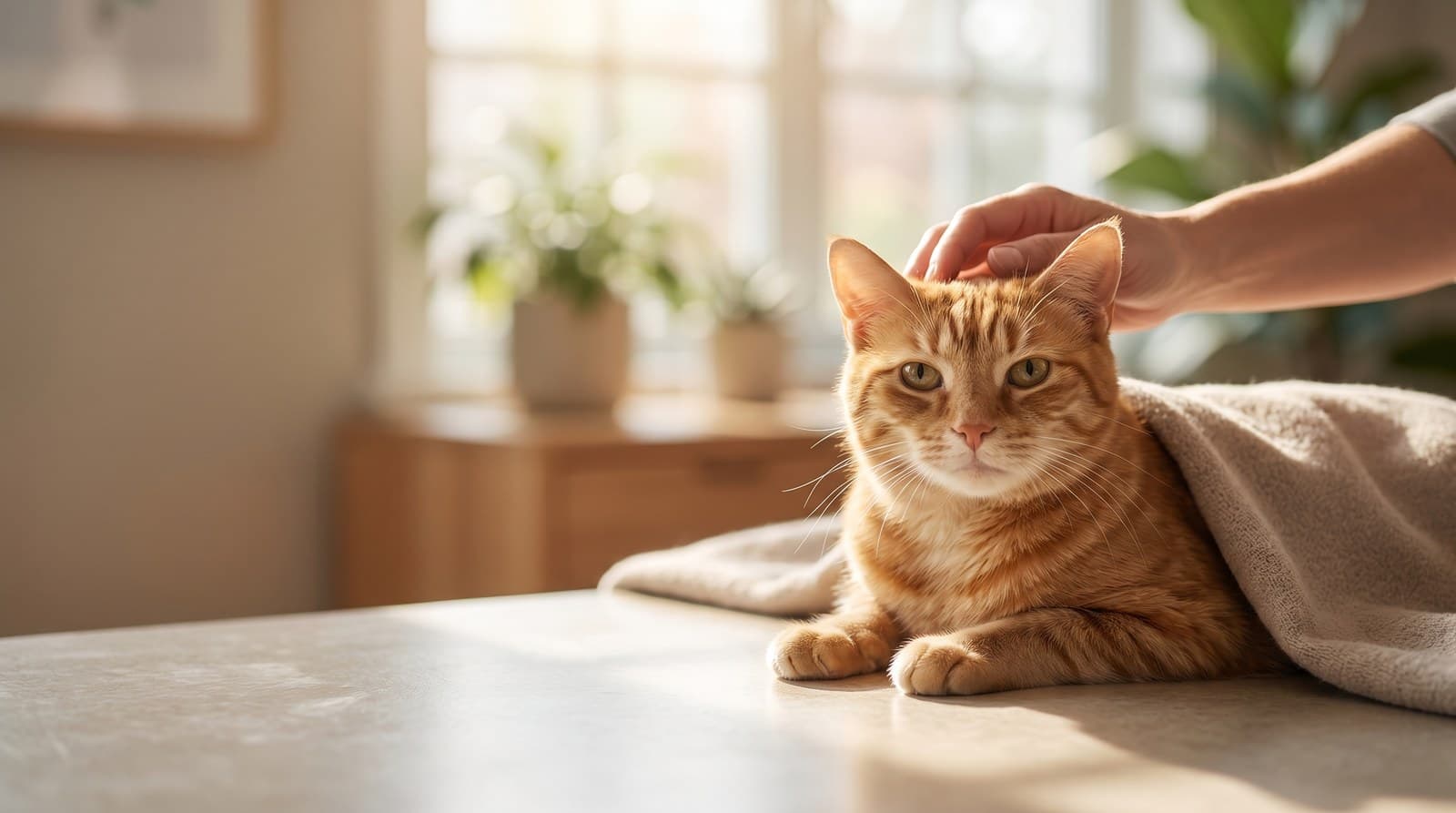
For your pet, a session is calm and undramatic. They enter the clear chamber, settle onto a soft blanket, and rest while the pressure and oxygen are gently adjusted. There are no needles and no sedation. A trained team monitors the whole session. Most pets relax quickly, and many simply sleep.
Three quick stories
Real patients from our clinic — a range chosen deliberately, including a palliative case, to show what HBOT realistically does and doesn’t do.
DIO — Schnauzer, 4 years old — paralysed to walking, no surgery
DIO arrived completely flat after a sudden grade 5 spinal disc injury. Managed conservatively with HBOT and rehab — no surgery — he was back to regular walks within about two months, and later managing 30-minute walks and jumping onto the sofa.
COOKIE — cat, 14 years old — quality of life with a brain tumour
COOKIE, a cat with an MRI-confirmed brain tumour, has had the most sessions of any of our patients. One month into treatment she was “walking better,” and over time her head tilt eased. Here HBOT was about comfort and quality of life, not a cure — and she has lived well far beyond the typical expectation for her diagnosis. An honest example of supportive, palliative use.
YONG EN — Miniature Schnauzer, 15 years old — a same-day change
YONG EN showed a measurable change in a single session: before HBOT, paw-position reflexes were absent or delayed in the hind legs; after one 30-minute session, the therapist recorded those reflexes returning, with the dog more alert. A concrete illustration of the mechanism at work.
Honest expectations. HBOT is a supportive therapy, not a miracle cure. It helps most as part of a complete plan, results vary by condition and individual, and some cases use it for comfort rather than recovery. We’ll always give you a realistic picture for your pet before you commit.
Frequently asked questions
Curious whether HBOT could help your pet?
The best way to find out if HBOT is right for your dog or cat is a proper assessment — so we can match the therapy to your pet's condition before you commit to a full program.
Montalbano C, Kiorpes C, Elam L, Miscioscia E, Shmalberg J. Common Uses and Adverse Effects of Hyperbaric Oxygen Therapy in a Cohort of Small Animal Patients: A Retrospective Analysis of 2,792 Treatment Sessions. Front. Vet. Sci. 2021;8:764002. doi:10.3389/fvets.2021.764002