How to Speed Up Dog Recovery After Surgery | RehabVet
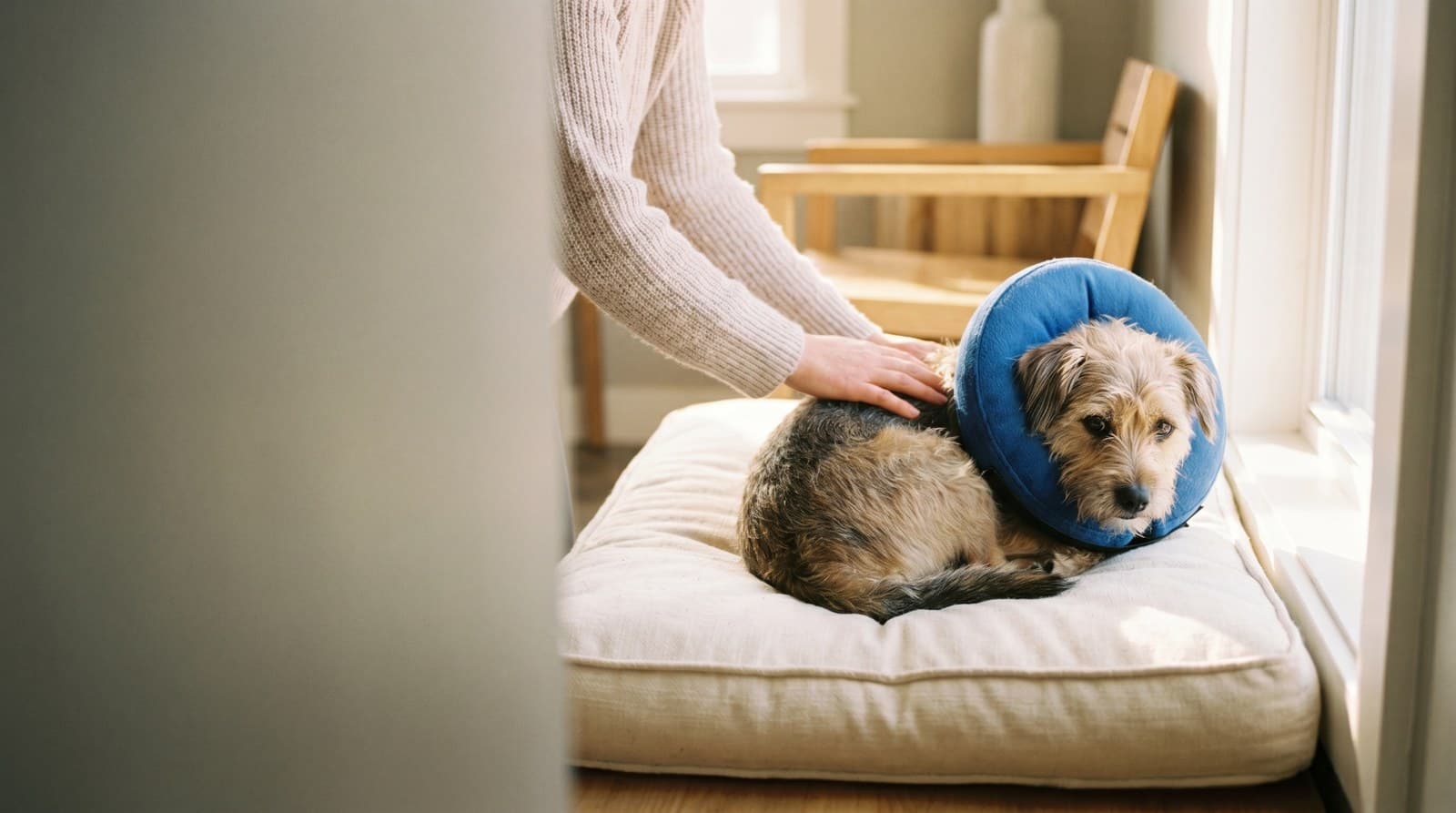
Your dog has come through surgery — a spinal hemilaminectomy, a cruciate repair, a mass removal, an FHO — and now you’re home with a cone, a crate, and a sheet of discharge instructions. The natural question is: is there anything I can actually do to help my dog heal faster and more comfortably, or do we just wait?
The honest answer is that recovery speed is not fixed. “Crate rest and time” is the baseline, but it isn’t the ceiling. The body heals at the pace its tissues get oxygen, nutrients, and the right amount of controlled movement — and each of those can be supported. This article explains what actually limits healing after surgery, the evidence-based ways to speed it up, where hyperbaric oxygen therapy (HBOT) fits, and what post-operative recovery looks like across the surgical cases we’ve treated at our rehabilitation clinic in Singapore.
Always follow your surgeon first. Every recovery plan in this article is an addition to your surgeon’s instructions, never a replacement. Rehabilitation should start only when your surgeon confirms the surgical site is stable enough — timing depends on the procedure. When in doubt, ask the surgeon before starting anything new.
The post-surgery healing timeline — and what actually limits it
Most soft-tissue and orthopaedic wounds move through the same broad phases: an early inflammatory phase (roughly the first few days), a repair phase where the body lays down new tissue (the following weeks), and a longer remodelling phase where that tissue gains strength (weeks to months). Nerve and spinal recovery runs on its own, often slower, timeline.
What sets the pace through all of it is blood supply and oxygen. Healing tissue has a high metabolic demand; new blood vessels, immune cells, and the collagen that rebuilds the site all depend on a good oxygen supply reaching the wound. After surgery, the area is often swollen and inflamed, which can compromise that very supply at the moment the tissue needs it most. This is the bottleneck most of the methods below are designed to relieve.
Five evidence-based ways to accelerate recovery
No single thing is a magic switch. Faster, smoother recovery comes from stacking several supports together — the same multi-modal approach we use in the clinic:
- Get nutrition right. Healing is a building project, and protein is the raw material. A dog that’s eating well, at a healthy weight, and adequately hydrated heals faster. Excess weight also loads healing joints and spines, so weight management matters for orthopaedic cases.
- Controlled rehabilitation, not just rest. Total inactivity causes muscle to waste and joints to stiffen. Once your surgeon clears it, gentle, controlled dog physiotherapy — passive range-of-motion, targeted exercises, balance work — rebuilds strength and the brain-to-limb connection without stressing the surgical site.
- Hydrotherapy and the underwater treadmill. Water buoyancy lets a dog use the limb and rebuild muscle while carrying only a fraction of its body weight — ideal for orthopaedic and spinal recoveries where full weight-bearing isn’t safe yet.
- Therapeutic laser. Photobiomodulation (laser therapy) is widely used over surgical sites to help manage pain and support tissue repair, and integrates easily into a rehab session.
- Hyperbaric oxygen therapy (HBOT). Saturating the blood with oxygen under pressure targets the exact bottleneck above — getting oxygen to swollen, poorly-perfused healing tissue. More on this next.
HBOT after surgery: why surgeons refer to us
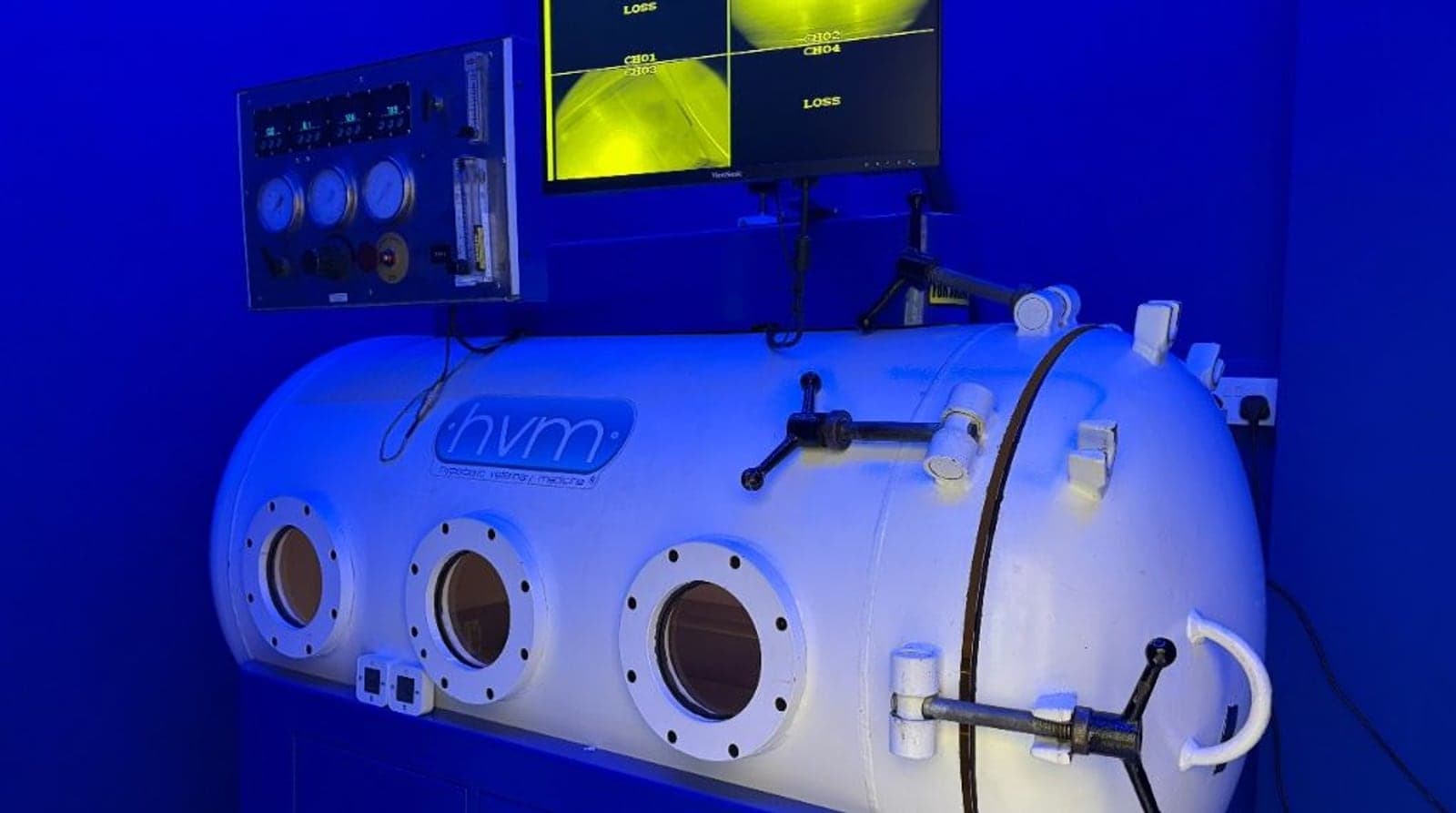
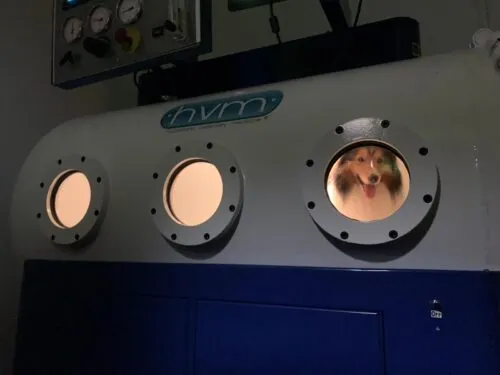
Hyperbaric oxygen therapy places your dog in a pressurised chamber breathing a high concentration of oxygen. Under pressure, far more oxygen dissolves directly into the blood plasma, so it can reach tissue that swelling and disrupted circulation are otherwise starving. The session is non-invasive, needs no sedation, and typically lasts around 30–60 minutes.
For a fresh surgical site, the goals are practical: support oxygen delivery to the healing tissue, help control swelling and inflammation, and give the body’s repair processes the resource they’re short of. It’s used most for spinal/neurological surgery recovery, wound and soft-tissue healing, and cases where a site is slow to recover.
This is a mainstream veterinary application, not a fringe one. In the largest published veterinary HBOT dataset to date — a retrospective analysis of 2,792 treatment sessions — neurologic injuries (50.4%) and tissue healing (31.4%) together accounted for the overwhelming majority of use. That same study, covering small animals treated between November 2012 and February 2020, recorded only minor adverse events in a handful of dogs (agitation in two, vomiting in three), consistent with HBOT’s strong safety profile under proper supervision.
Crucially, HBOT is one component of a recovery plan, not a standalone cure. The dogs who recover best are on a complete program — nutrition, controlled rehab, hydrotherapy, and HBOT working together.
Real post-surgery recoveries
These are real patients from our clinic, each recovering from spinal or orthopaedic surgery with a post-operative rehabilitation program that included HBOT.
MOMO — Chihuahua, 15 years old — crossing a step again
MOMO had a double hemilaminectomy (L2-L3 and T12-L1) after severe disc protrusions caused sudden loss of coordination. In the post-operative window she started a combined program of HBOT, hydrotherapy, Tui Na, and rehab. A few months on came the milestone every owner waits for: “first time able to cross a step to the toilet — hasn’t been able to do that since surgery.” By the following year the owner felt her legs were stronger, with paw-position reflexes returning in a hind limb. A small, concrete win that meant a great deal at home.
HAPPY — Dachshund, 3 years old — the classic IVDD surgery, accelerated
HAPPY needed a hemilaminectomy at T13-L1 — the textbook Dachshund disc surgery. A short, focused course of HBOT in the immediate post-operative window, alongside rehab, supported a recovery the therapist recorded as “improved neuro sensation in both hind legs and increased strength.” A young dog given every advantage to bounce back from a serious spinal operation.
Cocoa — Dachshund, 6 years old — from the most severe grade, recovering
Cocoa came in after surgery for a grade 5 IVDD (T3-L3) — deep-pain-negative, the most severe presentation. With post-operative HBOT and rehabilitation, the clinical notes tracked genuine progress: from grade 5 toward grade 3 functioning and “recovering well”. An honest example that even the hardest surgical cases can regain ground with structured support — while still setting realistic expectations.
YOGI — Pomeranian, 4 years old — long-haul recovery after neck surgery
YOGI underwent ventral slot surgery (C5-C6) for a cervical disc extrusion that had left him with limb weakness, on top of hip dysplasia and OA. His was a long, committed recovery — one of the most sustained HBOT-and-rehab courses we’ve run — illustrating that complex, multi-problem cases often need a marathon rather than a sprint, and that consistent multi-modal support pays off over time.
Honest expectations. Recovery speed and extent vary with the procedure, the dog’s age, and any concurrent conditions — and not every case recovers fully. We don’t promise a fixed timeline or a guaranteed result. What we offer is an assessment-first plan, coordinated with your surgeon, and a realistic picture from the start.
What a post-op program at RehabVet looks like
Every plan is built around the procedure and your surgeon’s clearance, but the shape is usually similar:
- Assessment first. We review the surgical report and your dog’s current function, then agree a starting point and goals with you.
- Early phase. Gentle, site-protective work — pain and swelling management, passive movement, and HBOT where indicated — timed to the surgeon’s clearance.
- Building phase. Progressive strengthening, hydrotherapy, and coordination work as the site stabilises, with a home-exercise program so progress continues between visits.
- Review and adjust. Regular reassessments to track function and adapt the plan.
On cost: pricing is discussed transparently at your assessment. We’ll always set out the expected frequency and package options up front before you commit.
Frequently asked questions
Helping your dog recover from surgery? Start with an assessment If your dog is recovering from an operation and you want to give it the best, fastest, most comfortable recovery, the next step is a proper assessment — coordinated with your surgeon — so we can build a plan around the procedure and your dog’s current function. → Book an Assessment
Montalbano C, Kiorpes C, Elam L, Miscioscia E, Shmalberg J. Common Uses and Adverse Effects of Hyperbaric Oxygen Therapy in a Cohort of Small Animal Patients: A Retrospective Analysis of 2,792 Treatment Sessions. Front. Vet. Sci. 2021;8:764002. doi:10.3389/fvets.2021.764002
Want to support recovery after surgery?
RehabVet coordinates post-surgical physiotherapy and hydrotherapy with your surgeon’s protocol.