Why Your Dog’s Back Legs Are Getting Weak
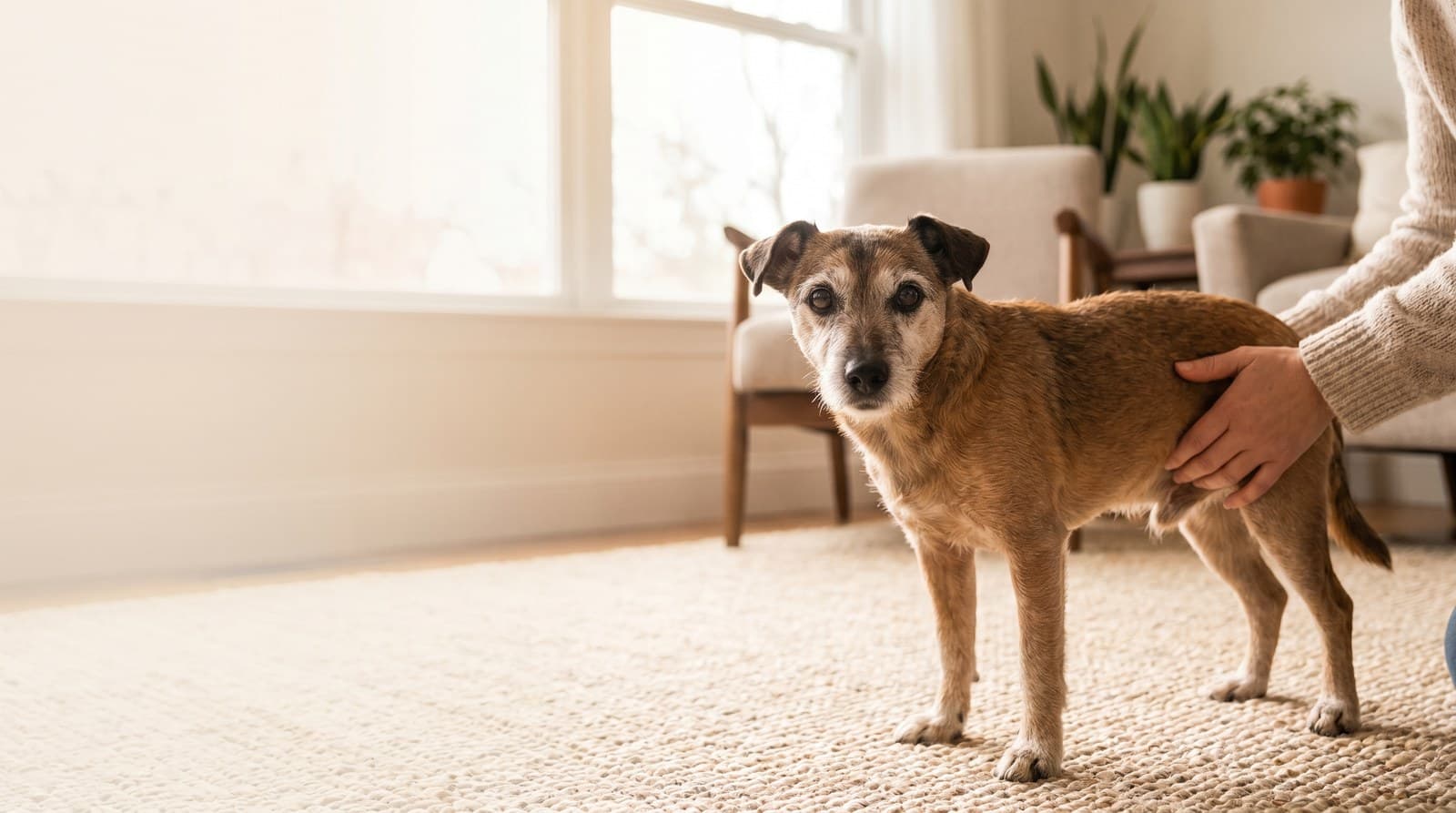
You’ve probably noticed it gradually: your dog’s back end looks a little lower, the walks are slower, there’s a wobble or a slip on the floor that wasn’t there last year. Or it came on suddenly — one day the back legs simply gave out. Either way, “weak hind legs” is one of the most common and most worrying changes owners see, especially in older dogs.
The good news: hind-leg weakness is a symptom, not a diagnosis — and many of its causes can be slowed, managed, or meaningfully improved. The key is finding out which cause you’re dealing with, because the right treatment is completely different depending on the reason. This article walks through the six common causes, how to tell which one it might be, when it’s an emergency, and what actually helps — including real recoveries from our rehabilitation clinic in Singapore.
The 6 common causes of hind-leg weakness in dogs
Weak back legs usually trace back to one (or a combination) of these. Use this as a starting map, not a diagnosis — several can look alike from the outside, which is why an exam matters.
| Cause | What it tends to look like |
|---|---|
| Osteoarthritis (OA) / <a href="/conditions/hip-dysplasia-dog-physiotherapy/">hip dysplasia</a> | Slow, gradual stiffness; worse after rest or cold; difficulty rising, jumping, or doing stairs. The most common cause in senior dogs. |
| <a href="/conditions/intervertebral-disk-disease-ivdd-dogs/">IVDD</a> / spinal disc disease | Can be sudden or gradual; wobbliness, dragging, knuckling of the paws, sometimes pain or a hunched back. |
| Degenerative myelopathy | Slow, painless, progressive loss of coordination in the back legs; common in older large breeds; worsens over months. |
| Vestibular / neurological | Often sudden; head tilt, falling to one side, circling, loss of balance — more a balance problem than pure weakness. |
| Metabolic / systemic | General weakness from conditions like heart, kidney, or hormonal disease; often the dog seems “off” overall, not just in the legs. |
| Muscle loss (sarcopenia) | Age-related thinning of the muscles that support the hips and spine; reduces power and stability over time. |
Two clues worth noting before your vet visit: how fast it came on (sudden vs gradual) and whether there’s pain. A sudden, painful collapse points in a very different direction from a slow, painless decline — and that distinction shapes both the diagnosis and the urgency.
When weak back legs are an emergency
Most hind-leg weakness can be assessed in a normal appointment. But some signs mean you should see a vet the same day, because the treatment window matters:
See a vet today if your dog has: • Suddenly become unable to stand or walk on the back legs. • Lost the ability to feel its back legs, or is dragging them with the tops of the paws scraping the ground. • Lost control of bladder or bowels. • Severe pain — crying out, a rigid or hunched back, or distress when touched. With spinal injuries in particular, how quickly your dog is assessed can affect the outcome. When in doubt, treat it as urgent.
What strengthening actually looks like (it’s not just supplements)
When owners ask how to strengthen weak hind legs, they’re often hoping for a supplement or a single fix. Supplements and good pain control have a place, but rebuilding real strength and stability takes targeted, progressive work — the same approach a physiotherapist would use for a person. In the clinic that means:
- Underwater treadmill (hydrotherapy). Water supports the dog’s weight so it can move the legs and rebuild muscle safely, long before it could manage the same work on land — the single most useful tool for rebuilding hind-end strength.
- Targeted land exercises. Sit-to-stands, controlled walking over poles, balance and coordination work that re-train the back legs and core.
- Hands-on therapy. Physiotherapy, massage, and TCVM Tui Na to ease stiffness and improve range of motion.
- Pain management. A dog in pain won’t use the limb, and disuse causes more weakness — controlling pain is what makes the strengthening possible.
- A home program. Simple daily exercises and home adjustments (rugs for grip, ramps, supportive harnesses) that keep progress going between visits.
Where hyperbaric oxygen therapy fits
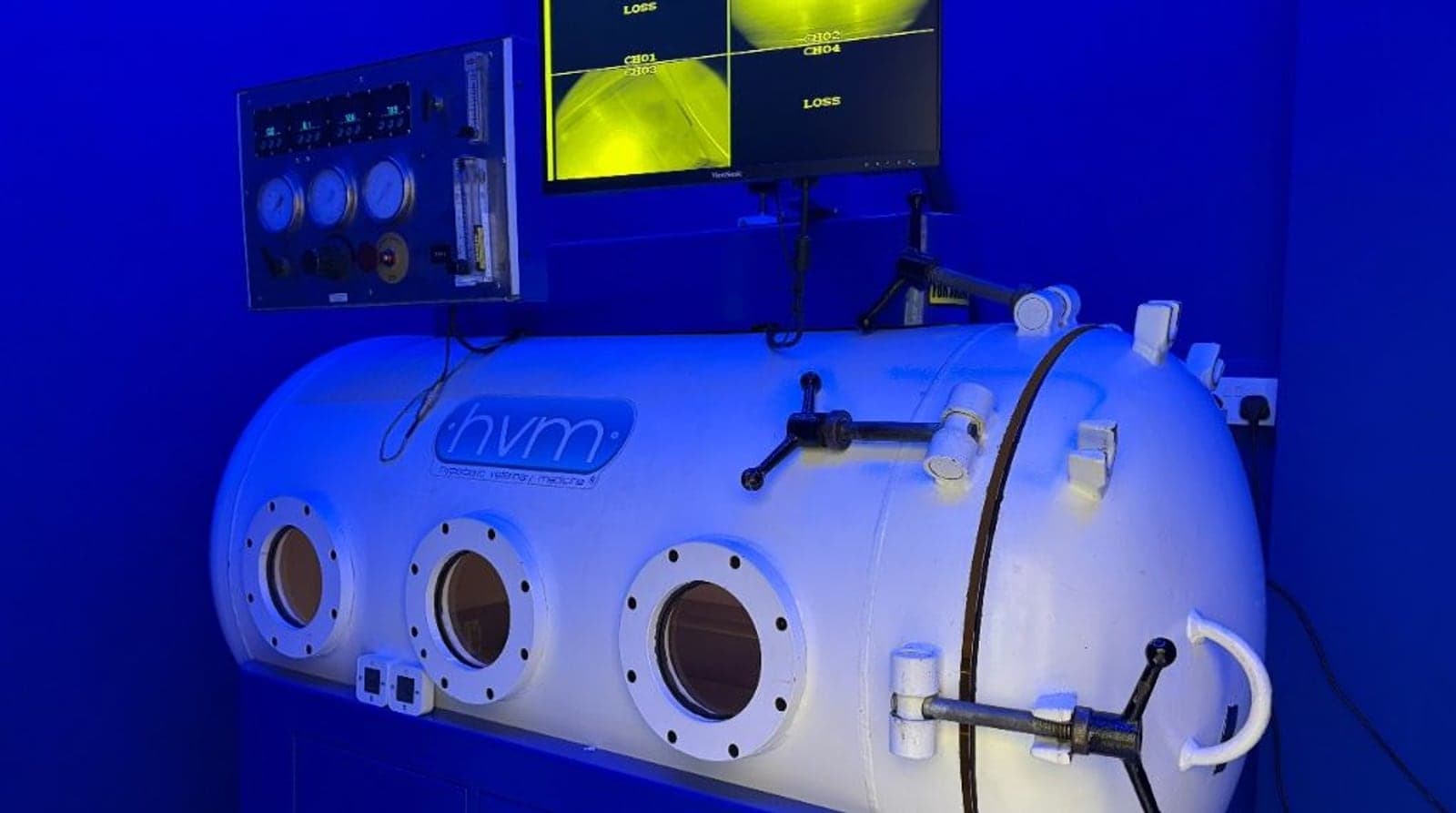
When the weakness is nerve-related — a spinal disc injury, a neurological event, or recovery after spinal surgery — hyperbaric oxygen therapy (HBOT) can be a useful part of the plan. The dog rests in a pressurised chamber breathing a high concentration of oxygen, which drives more oxygen into the blood and out to tissue that swelling and poor circulation are otherwise starving. The aim is to calm inflammation around the injured nerves and support the body’s own repair.
It’s a mainstream veterinary use: in the largest published veterinary HBOT dataset to date — 2,792 treatment sessions — neurologic injuries were the single most common indication at 50.4%, with tissue healing next at 31.4%. That study, covering small animals treated between November 2012 and February 2020, recorded only minor adverse events in a handful of dogs, consistent with HBOT’s strong safety profile under supervision. As always, HBOT works best as one part of a complete rehab program, not on its own.
Real recoveries: dogs who got their back legs back
These are real patients from our clinic, each with a different underlying cause of hind-leg weakness — a reminder that the right plan depends on the diagnosis.
Simba Lye — Pomeranian, 8 years old — couldn’t walk to walking by himself
Simba suddenly lost the ability to walk over a couple of weeks, on top of long-standing joint instability. With a combined program of HBOT, rehab, hydrotherapy, and Tui Na, the change came steadily: ten days in he was “able to move faster than before,” and by the end of the course “he can walk at home by himself,” with paw-position reflexes back in all four legs months later.
MUDDY — Pug, 15 years old — standing longer, taking steps
MUDDY had lumbosacral disease and hip arthritis, and at 15 could manage only five to ten minutes before tiring, half-squatting as he went. Over a sustained rehab-and-HBOT program the notes tracked real gains: “doing better after HBOT, less sliding,” then later willing to stand for ten minutes longer than usual and “willing to take a few steps,” with the lumbosacral area no longer as painful and the right hind leg noticeably stronger.
GIGANTIC — Rottweiler, 14 years old — a big dog standing again
GIGANTIC, a 14-year-old Rottweiler with arthritis across multiple joints, had been struggling to stand and sleeping most of the day. After a program of HBOT, rehab, and hydrotherapy, the owner reported he was “able to stand up quickly from lying position” with improved stiffness, then “doing better now, able to stand up and move around,” with his appetite back too — a meaningful result in a large senior dog where mobility is especially hard to regain.
BABY — Maltese, 19 years old — mobile at nineteen
Proof that age alone isn’t the barrier: BABY, at 19, with early spinal disease and knee arthritis, was after her program “able to walk and get up from recumbency actively,” pottering around the house with and without her wheelchair, paw-position reflexes normal in all four limbs.
Honest expectations. Not every dog regains full strength — some causes are progressive, and results depend on the diagnosis, the dog’s age, and how early treatment starts. We don’t promise a cure. What we offer is an honest assessment of what’s realistic for your dog, and a plan to get the most function and comfort possible.
Frequently asked questions
Noticing your dog’s back legs getting weaker? Start with an assessment Because weak hind legs can come from so many different causes, the most useful first step is a proper assessment — so you know what you’re actually dealing with and what can realistically help, before committing to any one approach. → Book an Assessment
Montalbano C, Kiorpes C, Elam L, Miscioscia E, Shmalberg J. Common Uses and Adverse Effects of Hyperbaric Oxygen Therapy in a Cohort of Small Animal Patients: A Retrospective Analysis of 2,792 Treatment Sessions. Front. Vet. Sci. 2021;8:764002. doi:10.3389/fvets.2021.764002
Worried about your dog’s weak hind legs?
Book an assessment — we’ll identify likely causes and start a physiotherapy and rehab plan.