Poodle Health Problems: The Joint and Spine Issues We See Most in Singapore (289 Dogs Treated)
Why we wrote this guide for Poodle owners
Poodles are the breed we see most often at RehabVet. Our records show 289 Poodles through the clinic, which is more than any other breed. That number does not mean Poodles are fragile dogs. It reflects how popular toy and miniature Poodles are in Singapore flats, and how many owners notice small changes in the way their dog walks and decide to get them checked.
This guide covers the poodle health problems that bring these dogs to a rehabilitation vet: kneecaps, hips, backs and the joints of older dogs. It is written for owners who are researching the breed or worried about something they have seen at home. If you want the figures and patterns behind our Poodle caseload, see our Poodle breed page in the June 2026 impact report.
We have not covered skin, eye, ear or hormonal conditions here. Those matter just as much, and your regular vet is the right person for them. Our focus is movement: what goes wrong, what it looks like, and what can be done.
Luxating patella: the most common reason toy Poodles skip
A luxating patella is a kneecap that slips out of its groove at the front of the knee. In toy and miniature Poodles it usually slips towards the inside of the leg. The classic sign is a skip: your dog runs normally, suddenly lifts one back leg for a few strides, then puts it down again as if nothing happened. That skip is often the kneecap popping out and then back in.
Vets grade luxation from 1 to 4. A grade 1 kneecap can be pushed out by hand but sits in place on its own. A grade 4 kneecap stays out all the time and the leg may look bow-legged. Many toy Poodles live with a low-grade luxation for years, while others develop pain, arthritis or a damaged cruciate ligament because the knee is not tracking straight.
Our page on luxating patella in dogs explains grading and treatment in more detail. In short, mild cases often do well with muscle strengthening, weight control and careful exercise. Higher grades, or dogs that are lame more often than not, may need surgery, and physiotherapy before and after the operation helps the leg recover.
Legg-Calvé-Perthes disease in young toy Poodles
Legg-Calvé-Perthes disease affects the head of the thigh bone, where it sits in the hip socket. The blood supply to that part of the bone fails, the bone weakens and collapses, and the hip becomes painful. It shows up in small breeds, usually between about four and twelve months old.
The signs can look like a kneecap problem at first. A young Poodle may hold up one back leg, limp more after play, or lose muscle over the thigh on one side. Some dogs resent having that hip moved. Because the two conditions can look alike, X-rays are important before anyone settles on a plan.
Treatment is usually surgery to remove the damaged bone, followed by a structured rehabilitation programme so the muscles take over the job of supporting the hip. Our page on Legg-Calvé-Perthes disease covers what recovery looks like. Dogs that start gentle, guided exercise early after surgery tend to use the leg sooner and keep more muscle.
Want a vet to look at how your pet is moving?
A rehabilitation assessment looks at pain, gait and what should happen next. You leave with a plan, whether that is physiotherapy, hydrotherapy or a referral back to your own vet.
Back problems and neck pain in Poodles
Poodles are not as strongly linked with disc disease as Dachshunds, but we still see poodle back problems regularly. Intervertebral disc disease happens when a disc between the vertebrae bulges or ruptures and presses on the spinal cord. Signs range from a hunched back and reluctance to jump, to wobbly back legs, to complete loss of use.
Toy breeds can also have problems at the top of the neck, where the first two vertebrae meet. A dog with neck pain may hold its head low, cry when picked up, or refuse to turn its head. Neck pain together with weakness in the legs is an emergency. So is any dog that suddenly cannot walk or stand. Go to an emergency vet first, not to a rehabilitation clinic.
Once a diagnosis is made and the spine is stable, rehabilitation has a real part to play. Our IVDD condition page explains the options, and our article on IVDD recovery without surgery covers what conservative care involves for suitable dogs.
Hips and elbows in Standard Poodles
Standard Poodles are a different size of dog, and their joint problems look more like those of other large breeds. Hip dysplasia, where the hip joint forms loosely, is the one we think about most. Signs include a swaying or bunny-hopping back end, stiffness after rest, and reluctance to climb stairs.
Standard Poodles are also deep-chested and athletic. Many of the ones we see are active dogs with soft tissue strains, or older dogs where hip dysplasia has become arthritis. Our hip dysplasia page describes how physiotherapy and hydrotherapy fit around medical or surgical treatment.
If you are choosing a Standard Poodle puppy, ask the breeder about hip scoring of the parents. It does not guarantee healthy hips, but it shifts the odds.
Arthritis and muscle loss in senior Poodles
Poodles often live well into their teens, and long life brings joint wear. Osteoarthritis develops slowly. Owners usually notice that the dog is slower to get up, hesitates before jumping onto the sofa, sleeps more, or turns back earlier on walks. Small dogs hide pain well, so these changes can be the only clues.
Older Poodles also lose muscle, especially over the back legs. Weaker muscles mean less support for the joints, which means more stiffness, which means less exercise. Breaking that cycle is a large part of what we do. Our guide to rehabilitation for senior pets explains how we approach older dogs, and our page on osteoarthritis in dogs covers the condition itself.
Early signs to watch for at home
You know your dog better than anyone. These are the changes we would like you to mention to a vet sooner rather than later:
Skipping or holding up a back leg, even briefly. Sitting with one leg pushed out to the side. Reluctance to jump onto furniture or into the car. Slipping more on tiled floors. Crying when picked up. A hunched posture or a tense belly. Licking at a knee or hip. Shorter walks, or stopping and sitting down partway. Toenails on one foot wearing more than the others.
Taking a short video of your dog walking on a non-slip surface is one of the most useful things you can bring to an appointment. Dogs often walk perfectly in the consult room because they are excited or nervous, and a video shows us what you see at home.
How a rehabilitation assessment helps
At RehabVet, a first assessment looks at how your Poodle stands, walks and trots, how each joint moves, where the muscles are thin, and where it hurts. We review any X-rays or reports from your regular vet. If something needs imaging or a surgical opinion first, we say so and refer back.
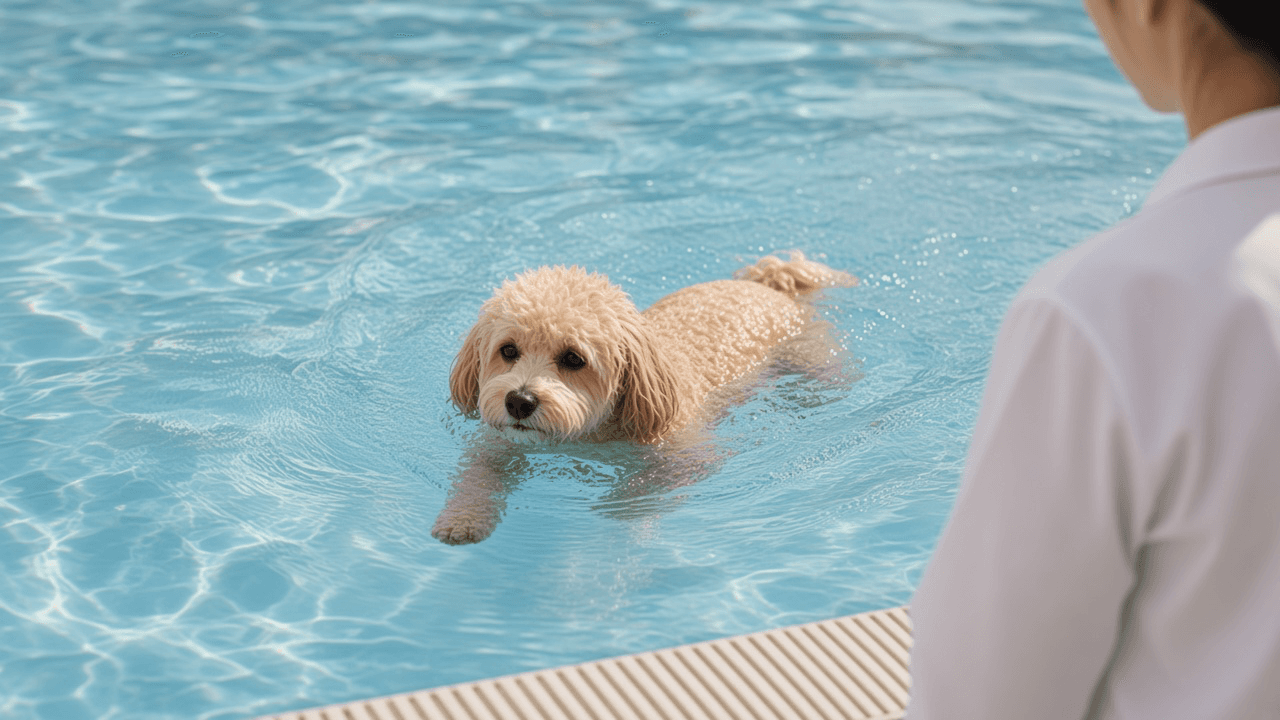
Treatment plans are built around the individual dog. For a toy Poodle with a slipping kneecap that may mean targeted strengthening, work in the underwater treadmill or saltwater hydrotherapy pool, and a home programme. For an older dog with arthritis it may combine physiotherapy with class 4 laser, acupuncture or other pain relief. Our home exercise guide shows the kind of work owners can do between visits.
Fees depend on the plan, and our pricing page sets out how they work. When you are ready, you can book an assessment at 513 Serangoon Road or call +65 6291 6881.
Keeping your Poodle's joints in good shape
Weight matters more than most owners expect. A toy Poodle carrying even half a kilo too much is carrying a large share of its body weight extra on small joints. Ask your vet what your dog's ideal weight is and measure food rather than guessing.
Non-slip flooring helps too. Rugs or runners over tiles in the areas your dog uses most reduce the sudden slips that strain kneecaps and backs. Ramps or steps for the sofa and bed spare the spine from repeated jumping. Regular, moderate walks build muscle better than an occasional long outing.
None of this prevents every problem, but it gives your dog's joints the best chance, and it makes recovery easier if something does go wrong.