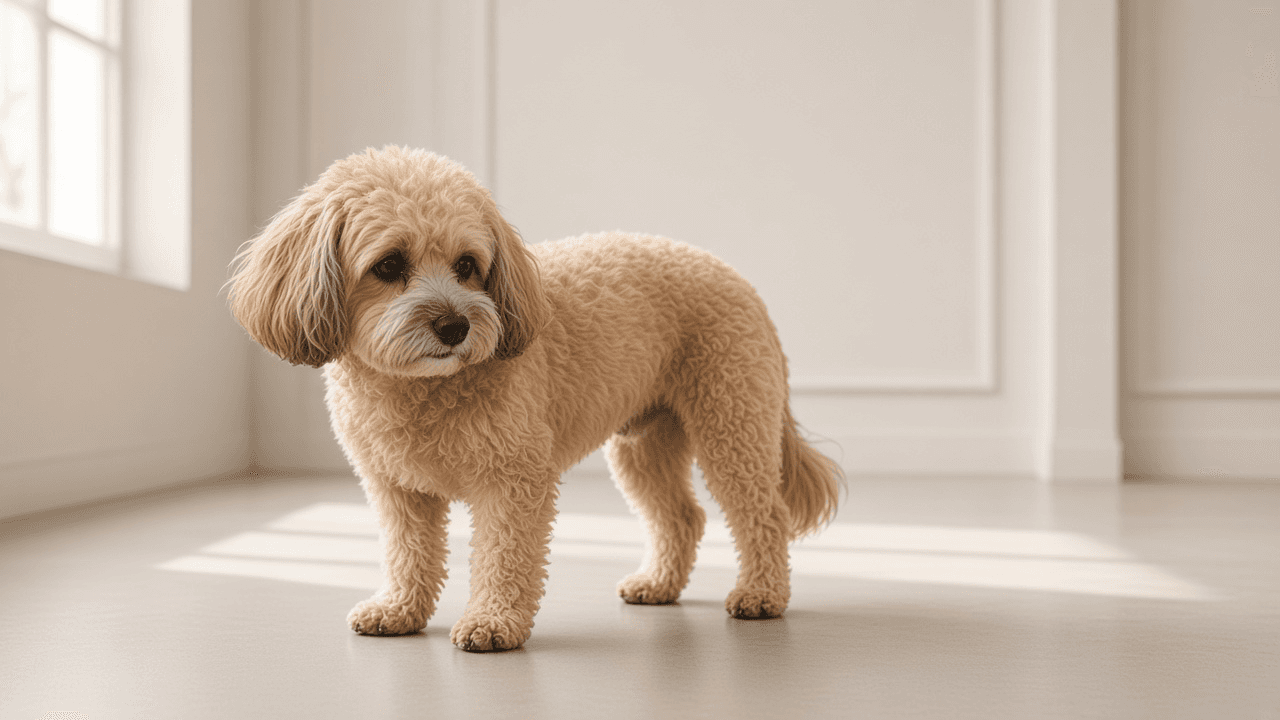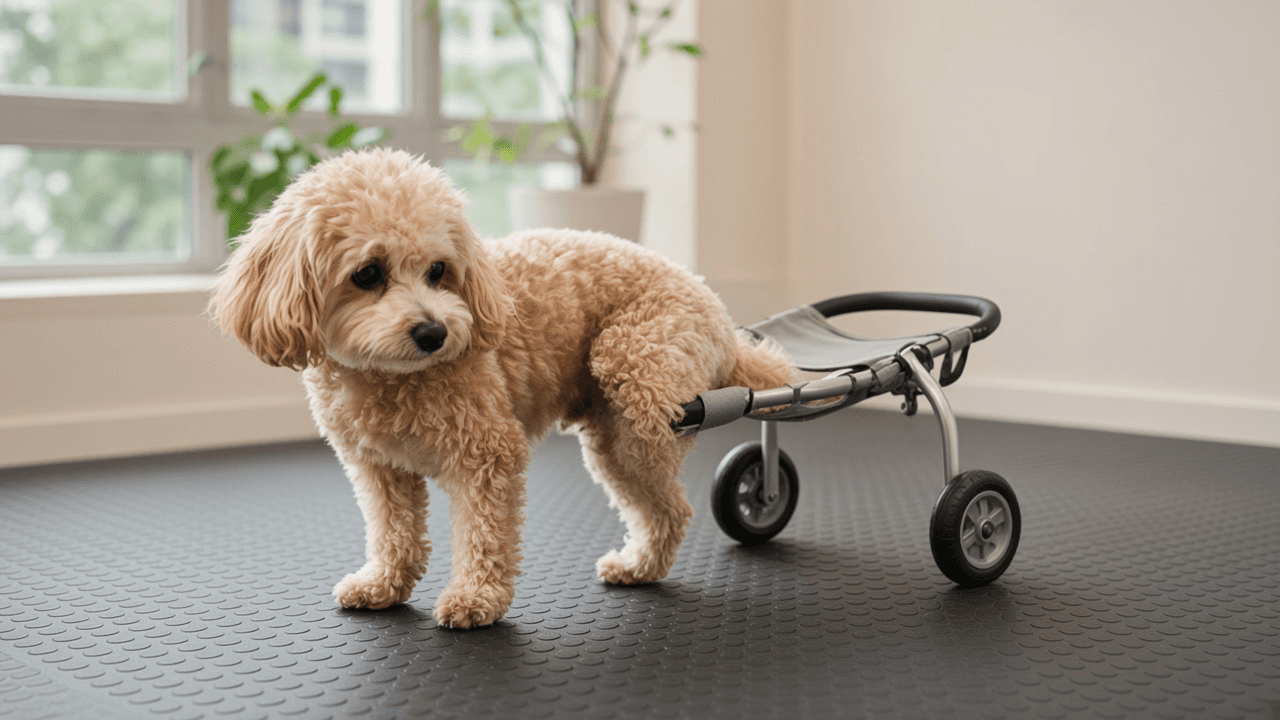
How to Pick Up and Carry a Dog With Back Pain or IVDD
The lift is part of the treatment
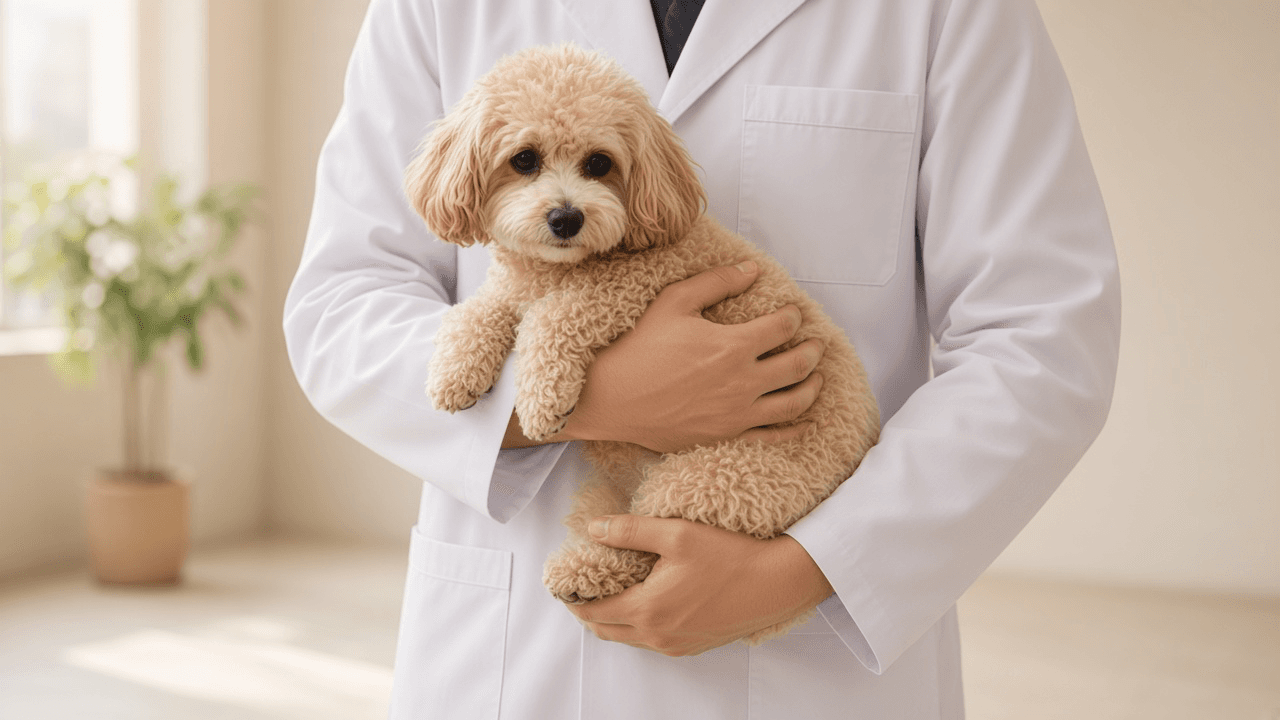
Knowing how to carry a dog with IVDD matters as much as the crate, because a single bad lift can flex a painful disc. The rule is simple to say and easy to break when you are late for the lift: the spine stays level. One arm supports the chest just behind the front legs. The other supports the pelvis. The back does not sag, twist or fold over your shoulder. You hold the dog close to your body, like a plank, not like a baby with the middle draped over your forearm.
If your dog became weak or paralysed today, cried out and cannot stand, or has neck pain with wobbly legs, do this lift once, into a car, and go to an emergency vet. Do not practise it in the living room. Do not give a human painkiller first. This article is the handling guide around a diagnosis or a suspected disc. The medical briefing is on our intervertebral disc disease page, and what IVDD is explains the condition in plain language. Read those after the dog is safe.
The lifts that hurt a back
Scooping under the belly folds the spine and is the most common mistake. So is lifting by the armpits so the back end dangles. So is a collar grab. So is letting a small dog jump into your arms and then clutching whatever you caught. A scruff is not a handle. A harness handle can help a stable dog on a walk, and it is a poor way to pick up an acute disc, because the weight still hangs from the chest and the back bows. If you already use a harness, unclip the lead before you lift so you are not fighting a taut line.
Children should not carry a sore dog, even if they want to comfort them. Visitors should be told, in one sentence, that the dog is not to be picked up. The other dog in the house is often the reason a careful plan fails. A nose under the belly is a lift you did not approve. Separate them for the rest period. Write the rule on a note by the crate if more than one adult shares the care. The dog does not need everyone to have a slightly different technique.
Small dogs: one person, two arms
Kneel side-on rather than leaning over from a stand, so you are not dropping the dog into a curve as you straighten up. Slide one forearm under the chest, behind the point of the elbow, and the other under the pelvis, in front of the hind legs if they are drawn up. Bring the dog in to your chest as you stand, using your legs. Keep the head, the chest and the hips in one line. If the neck is also painful, do not let the head flop down or crank it up. Support the neck in the position the dog is already holding.
Long-backed dogs need this hold the most. Among dogs treated at RehabVet, 66 were Dachshunds and 92 were Corgis. Those figures are clinic volume, not a count of disc cases, but they are why lifting technique is a daily conversation here. A Dachshund's spine is long relative to the legs, and a belly scoop bends a long lever. The same two-arm hold works for a Shih Tzu or a mixed-breed dog. Size changes the logistics. It does not change the rule that the back stays straight. If you cannot do it without the spine folding, ask for a second person rather than improvising.
Want a vet to look at how your pet is moving?
A rehabilitation assessment looks at pain, gait and what should happen next. You leave with a plan, whether that is physiotherapy, hydrotherapy or a referral back to your own vet.
Medium and large dogs: two people or a board
One person should not hero-lift a Labrador with a suspected disc. Two people stand on the same side. One takes the chest, one takes the pelvis, and you lift on an agreed count so the dog does not twist away from the slower hand. Keep the back level between you. A third person opens doors and handles the lead, which should not be attached to a collar pull. If the dog is too painful to coordinate this, use a board.
A firm board, a removed shelf, or a proper stretcher is better than a soft blanket for a dog who cannot walk. Roll or slide them onto it with as little twisting as possible, then carry the board, not the dog. In the car, the board lies flat. A person sits beside them so the board does not slide when you brake. A blanket sling can work for a very short lift if two people hold the ends and stop the middle from sagging. A sagging sling is just a slower belly scoop. If you only have one person and a heavy dog, phone the clinic and ask for help rather than dragging them across tile.
Toileting without a walk
Most disc plans allow a brief toilet trip and forbid a sniff-walk. Carry the dog to a non-slip or grassy spot close to the door. Support them in a stand only if the vet has said standing is allowed. A towel under the belly can help a dog who is allowed to bear some weight, as long as the towel does not hoist the middle of the spine into a curve. Keep the lead on. The moment they finish, lift them the same way and go back to the crate. Do not let them shake, trot or visit the other dog as a reward.
If they cannot stand even with support, ask the vet how they want urine and stools managed. Do not invent a sling workout. A dog who has not passed urine, or whose bladder feels like a tight ball, needs a vet the same day. Leakage is not the same as emptying. Cleaning urine off the skin prevents scalds, and it is not evidence that the bladder is safe. Mention toileting at every recheck. It is a neurological sign, not a housekeeping detail.
Stairs, cars and the HDB lift
Use the lift. If you live in a walk-up, plan the carry before the dog is desperate, and rest on a landing with the dog still supported rather than putting them down to scramble. Do not let them do even three steps. Stairs are a repeated flexion and a fall risk. In the car, lift them in. Do not pat the seat and hope they will hop. A ramp is for later, when the vet has said the spine can take a slope. During an acute episode the ramp is still a walk.
Hot car boots and loose dogs in footwells are a no. Air-conditioning on before they get in. A flat, non-slip surface. No other dog loose. If you are coming to RehabVet at 513 Serangoon Road, call +65 6291 6881 if the dog cannot walk, so we can advise you on arrival. If this is the first day of paralysis or rapidly worsening weakness, do not come to a rehabilitation appointment. Go to an emergency hospital. The carry technique is the same. The destination is different.
After the lift: the crate is the point
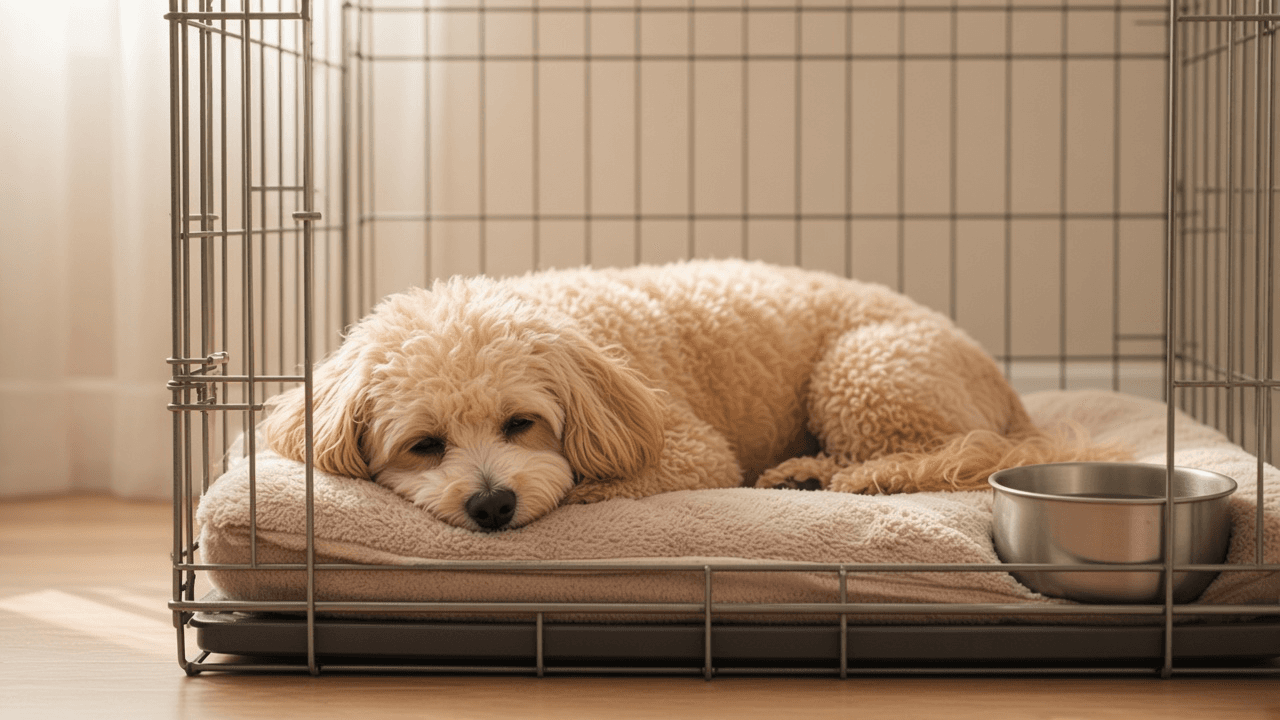
The best lift is the one you rarely need because the crate, the water and the bed are already in one small area. Every extra trip to the sofa is another chance to flex the spine. Set the convalescence room up before you are tired. A pen with no furniture to jump onto beats a whole flat policed by willpower. If you have to move them between rooms, do the full chest-and-pelvis carry even for ten steps. The short distance is where people get casual.
Rehabilitation exercises come later, when the vet says the disc is stable enough. Home exercises chosen from a video during week one are how relapses happen. When you are cleared for home work, use a plan written for this dog, and read home rehabilitation exercises only as background. The recovery pathway, including dogs managed without surgery, is outlined in IVDD recovery without surgery. Follow your own vet's version if it is stricter than anything you read.
Teaching the household one method
Pick one technique and make every adult demonstrate it back to you. The usual failure is the kindest person in the house, who scoops the dog up for comfort. Show them the plank hold. Show them where the hands go. Agree the words you will use so a painful dog is not surprised by a sudden arm. Keep a slip lead or a harness nearby only for the moment after the feet are on the ground, and do not attach it to a collar if the neck might be involved.
If you are unsure you are doing it safely, film yourself and ask the rehabilitation vet or the neurologist's nurse to watch the clip. Pride is less important than a straight spine. You can book an assessment when the dog is stable enough to be handled in a clinic, and you can see fees on the pricing page. Bring the carry question to that visit. We would rather correct a hand position than meet the dog again after a sofa lift. The technique is ordinary. The timing, during a disc injury, is not.